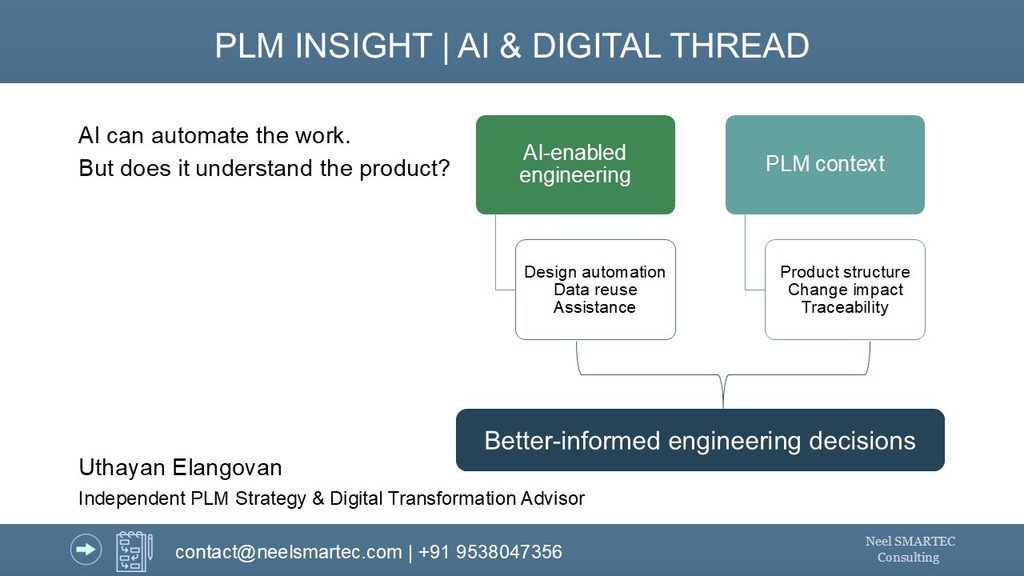
Autodesk’s recent announcements at Autodesk University 2026 caught my attention. AutoTimeline and AutoAssemble in Fusion aim to reduce manual work in design, while Autodesk is also developing an agentic PLM experience for Fusion Manage to connect product data, requirements, and work across teams. These are interesting developments. But as someone who has worked with PLM strategy and implementation, I keep coming back to a more practical question: when an engineer changes a part, how easily can the organisation understand what else is affected? Autodesk’s announcement describes the direction. The real test will be how these capabilities work in actual engineering processes.
During a PLM strategic consulting engagement with an Engineer-to-Order manufacturer, I asked how they managed suppliers for welding and painting. The answer was simple: “It all depends on the trust and our experience with the suppliers over a long period of time.” I understood that. Experience matters, and long-standing supplier relationships have real value. But what happens when the regular supplier is unavailable, a new project requires a different capability, or a drawing revision changes the requirements? Can the team readily identify the correct specifications, communicate them to the supplier and establish what needs to be checked? The conversation stayed with me because it highlighted how much operational knowledge can sit in people’s experience.
Now bring AI into that picture. An engineer changes a component, and the change may affect assemblies, the BOM, manufacturing documentation, and supplier requirements. AI could help locate related information and flag possible impacts. But finding a document is not the same as confirming that it is the correct revision, and identifying a possible impact is not the same as validating it. Autodesk’s proposed agentic PLM experience is interesting because it aims to connect product context, people, decisions, and next actions. Autodesk describes it as coming soon, with capabilities still in development. The question for manufacturers is how reliably such assistance can work with their actual product data, processes, and approval rules.
This connects with a point I explored in my AI in Manufacturing article: before asking where AI can be used, understand what needs to change in the business. It also connects with Engineering-to-Operations Intelligence, where engineering intent must carry through into manufacturing execution and operational decisions. PLM, ERP, QMS, and other systems may each hold part of the picture. The challenge is whether the relevant information and relationships can be followed across them. As I discuss in my Handbook of Product Lifecycle Management, PLM is about connecting business objectives, processes, people, and technology, not simply introducing a software platform.
So, before asking, “What can AI do for our PLM environment?”, I would ask something more basic: “Can we reliably trace the impact of an engineering change today?” If the answer is unclear, that is where I would start. AI may help teams work with product information more effectively, but the organisation still needs to establish where that information resides, how it is maintained and who is accountable for the decisions. That is the practical work behind making AI useful in PLM.
Planning a PLM or Digital Transformation Initiative?
Discuss your roadmap priorities, engineering data challenges, or PLM readiness gaps with Neel SMARTEC.
Schedule a Strategy Discussion