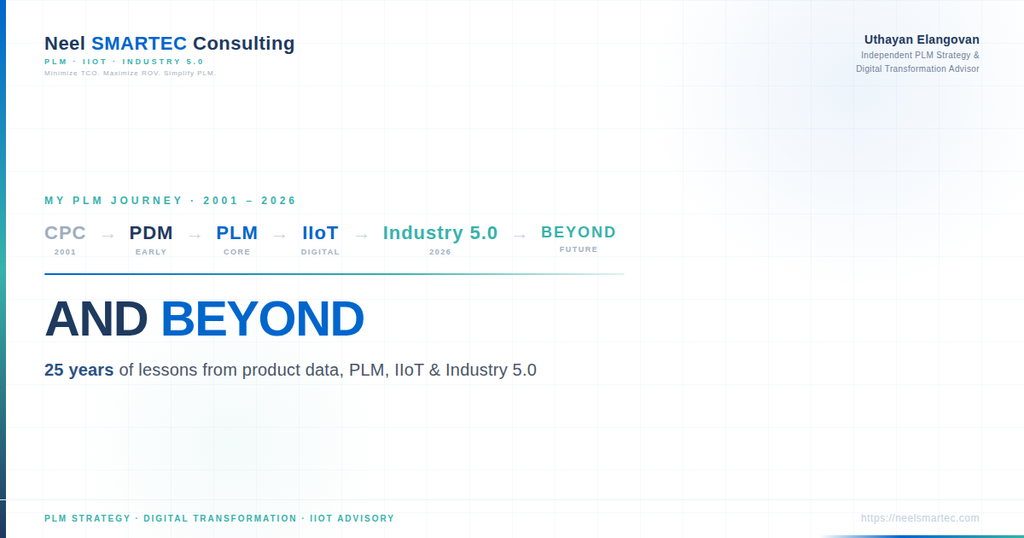
Reflection · 25 Years in PLM
My PLM Journey
Sometimes it is useful to go back to where a journey started.
In 2021, I wrote about my PLM journey after finding some of my postgraduate notes from 2001–2003. Those notes took me back to a time when Product Lifecycle Management was still relatively new to many manufacturing organisations, and when much of my learning was around PDM, product structures, engineering data and the early capabilities of Windchill.
Five years later, I looked at those same experiences differently.
The technologies have changed. The PLM platforms have evolved. Manufacturing organisations have become far more digital.
But many of the fundamental problems around product information, engineering processes, configuration, change management and collaboration remain remarkably familiar.
That is what makes this journey interesting.
It is not simply a journey from one version of PLM software to another.
It is a journey in understanding what PLM is really supposed to achieve.
It started with CPC, PDM and Windchill
My formal journey into this field began during my Master’s in Computer Integrated Manufacturing at PSG College of Technology between 2001 and 2003.
Among the material I studied were the foundations of product data management and the emerging concepts around Product Lifecycle Management.
I still remember going through early Windchill material, including the Windchill 4.0 foundation and later PDM material around Windchill 5.0.
At that stage, PLM was something I was learning.
Later, it became something I was implementing.
And eventually, it became something I started questioning and advising on.
That progression has probably been the most important part of my career.
The early Windchill years
The early years gave me an opportunity to understand PLM from the technology side.
I worked with concepts and capabilities such as:
- Windchill Factor
- Windchill Sourcing
- Enterprise Search
- Info*Engine
- Reuse Manager
- Product Configuration Management
- Product structures
- PDM fundamentals
- Object and data modelling
- CAD and product data management
I also had the opportunity to work with Pro/INTRALINK and Gateway architectures and understand how product information could move beyond engineering into other enterprise systems.
At the time, these were not just software features.
They were ways of answering practical engineering questions:
Where is the product information? Who owns it? Which version is correct? What changed? Who needs to know?
Those questions have stayed with me throughout my career.
PLM and ERP: seeing the bigger picture
One of the experiences that shaped my understanding of PLM was working with PLM and ERP together in a discrete manufacturing environment.
Working with Windchill, Pro/INTRALINK, Gateway architecture and Oracle manufacturing helped me understand something that became increasingly important later in my career:
PLM does not exist in isolation.
- Engineering creates product intent.
- Manufacturing needs executable product information.
- Procurement needs material and supplier information.
- Service needs the right configuration and documentation.
- ERP needs the information required to plan and execute the business.
The challenge is therefore not simply managing engineering data.
The bigger challenge is maintaining the right information and relationships across the product lifecycle.
That lesson became a recurring theme throughout my later work.
2007: a milestone I still remember
In 2007, I presented a paper titled “IT Involvement in Product Development (Automated B2B)” at the PTC World Conference in New Delhi.
It received the Best Presentation Award.
Looking back, the award was important, but the experience was more important.
It gave me an opportunity to step outside implementation work and think about the broader role of information technology in product development.
That distinction — between implementing technology and understanding how technology changes the business process — became increasingly important in the years that followed.
From Windchill 9 to Windchill 11
The journey continued through different manufacturing environments and different versions of Windchill.
I worked with Windchill 9.0 and 9.1 and subsequently through Windchill 10 and Windchill 11 environments.
The industry contexts were very different:
- HVAC
- Automotive
- Home appliances
- Medical devices
- Electronics and EMS
Each environment had its own products, processes, organisational structures and constraints.
But again, many of the underlying PLM questions were similar.
How should product data be structured? How should engineering changes be controlled? How should configurations be managed? How should engineering information reach downstream functions? How should different systems exchange information?
And perhaps the most difficult question:
How do we get people to actually use the process we designed?
This is where I started seeing PLM less as a software implementation and more as an organisational capability.
From implementation experience to a broader PLM perspective
Over time, my interest moved beyond the individual PLM system.
I started looking more closely at the relationship between:
People + Process + TechnologyA PLM system can provide the technology.
But it cannot, by itself, define good processes.
It cannot automatically establish ownership.
It cannot make people collaborate.
And it cannot guarantee business value.
That realisation gradually changed the way I looked at PLM projects.
The question was no longer only:
“How do we implement PLM?”
It became:
“What problem are we actually trying to solve, and what role should PLM play in solving it?”
2018: starting Neel SMARTEC
In 2018, I started Neel SMARTEC as an independent consulting practice.
The objective was to bring practical experience in PLM, IIoT and digital transformation to manufacturing organisations without being tied to a particular software vendor.
That independence became increasingly important.
Different organisations are at different stages.
- Some are still managing engineering information through shared folders, spreadsheets and email.
- Some have implemented PDM but struggle with adoption.
- Some have mature PLM platforms but use only a fraction of their available capabilities.
- Others are trying to connect engineering with manufacturing, ERP, IoT and operational systems.
The answer cannot always be “buy another system.”
Sometimes the real problem is the process. Sometimes it is governance. Sometimes it is organisational ownership. Sometimes the existing technology is capable enough but is simply not being used effectively.
PLM and IIoT: expanding the lifecycle view
My PLM experience eventually led to my first book in PLM after IIoT book: Product Lifecycle Management (PLM): A Digital Journey Using Industrial Internet of Things (IIoT).
The book was published by CRC Press and subsequently received the 2020 Taylor & Francis Award for Outstanding Professional Book. It was also recognised by BookAuthority in several industrial management and product design lists.
Writing that book made me look at PLM from another angle.
If PLM manages product knowledge, and IIoT provides information from connected products and operations, what happens when those worlds are connected?
The idea of a more continuous information flow started becoming increasingly important.
Engineering creates intent. Manufacturing executes that intent. Products operate in the field. Operational information comes back. That information can potentially influence future engineering decisions.
This is much broader than traditional PDM.
2021: writing about the journey
That thinking was the reason I wrote the original version of this article in June 2021.
At the time, I described the journey mainly through the technologies and PLM environments I had encountered.
Looking back now, I think I was only describing half the journey.
The more important evolution was happening in the way I was thinking about PLM.
PDM → PLMthen:
PLM → PLM + IIoTand gradually toward:
PLM → Digital Engineering → Engineering-to-Operations → Industrial Transformation2021–2026: the journey changes direction
The years after 2021 brought a different kind of learning.
The focus increasingly moved from individual PLM capabilities toward business outcomes.
Questions became more strategic:
- Is the organisation ready for PLM?
- What is the current capability and maturity?
- Where are the real engineering bottlenecks?
- How much value is the existing PLM investment actually delivering?
- Where does engineering information break down between functions?
- What should change first?
- Is new technology really required?
- How should PLM connect with ERP, manufacturing and operational systems?
- How do we measure value rather than simply implementation completion?
These questions influenced my consulting work as well as my writing.
They also reinforced something I had been learning throughout my career:
PLM maturity is not determined by the number of features a company owns.
It is determined by how effectively the organisation uses people, processes and technology to manage the product lifecycle.
From Industry 4.0 to Industry 5.0
The next major step in the journey was Industry 5.0.
The first edition of Industry 5.0: The Future of the Industrial Economy explored how industrial transformation was moving beyond automation and digitalisation toward a more human-centric and sustainable industrial model.
The second edition, published by CRC Press in 2026, expanded that thinking based on subsequent industry and consulting experience.
For me, this was a natural continuation of the PLM journey.
Industry 4.0 made us ask:
How can we connect and automate more?
Industry 5.0 makes us also ask:
Why are we doing it? How does it help people? How does it improve resilience? How does it create sustainable business value?
That changed the way I viewed digital transformation.
More technology does not automatically mean more transformation.
Technology needs a purpose.
2026: the PLM Handbook
In August 2026, another major milestone in this journey was reached with the publication of the Handbook of Product Lifecycle Management: Fundamentals, Components, and Implementation Best Practices by CRC Press / Taylor & Francis.
This book brought together many of the lessons accumulated over more than two decades of working with PLM.
The scope is broader than the original technology-centric view of PLM.
It covers PLM fundamentals, strategy, processes, implementation, governance, economics, emerging technologies and Industry 5.0.
The underlying idea is simple:
PLM has evolved from an engineering support system into a strategic business capability.
That does not mean the fundamentals have disappeared.
BOMs still matter. Part numbers still matter. Configurations still matter. Change management still matters. Documents and CAD data still matter.
But these are now part of a much larger product lifecycle conversation.
What 25 years of PLM has taught me
If I had to summarise the journey, I would not list the different Windchill versions I have worked with.
I would list the lessons.
-
1
PLM is not just a software system
It is a combination of people, processes, information and technology.
-
2
PDM is important, but it is only part of the story
Managing product data is foundational. Managing the product lifecycle is broader.
-
3
Integration is not the same as digital continuity
Connecting systems technically does not automatically create a meaningful flow of product information. The business process still needs to work.
-
4
PLM adoption matters as much as PLM implementation
A system can go live successfully and still fail to create value if users do not adopt the intended processes.
-
5
More functionality does not necessarily mean more value
A mature PLM platform with low utilisation can still represent a significant business opportunity. Before buying more technology, it is worth understanding what is already available and why it is not being used.
-
6
PLM should connect engineering with the rest of the business
Engineering should not operate as an isolated information island. The real value emerges when product information can support manufacturing, procurement, service, operations and business decisions.
-
7
Digital transformation should begin with the problem
Technology should follow the business need — not the other way around.
From “implement PLM” to “create value from PLM”
Perhaps this is the biggest change in my own thinking.
Early in my career, the question was often:
How do we implement PLM?
Later it became:
How do we improve the PLM process?
Then:
How do we connect PLM with other enterprise systems?
And today:
How do we create measurable business value from product lifecycle information?
That is a very different question.
It changes the starting point.
Instead of immediately discussing software, we first need to understand:
This is also why I increasingly believe that a PLM initiative should begin with readiness, capability and business priorities rather than with a software demonstration.
The journey is still continuing
When I found those old postgraduate notes in 2021, I was reminded of where everything started.
In 2026, looking back over more than 25 years, I realise that the most interesting part of the journey was not the technology itself.
Windchill evolved. PDM evolved. PLM evolved. IIoT emerged. Digital engineering expanded. Industry 4.0 became Industry 5.0. AI is now becoming part of the conversation.
But the fundamental question remains remarkably consistent:
How can an organisation manage product knowledge better and turn that knowledge into better decisions and better business outcomes?
That is the question that continues to interest me.
CPC → PDM
Learning the foundations of product data management.
PDM → PLM
Understanding the broader product lifecycle.
PLM → IIoT and digital engineering
Connecting engineering intent with operational reality.
Digital engineering → Industry 5.0
Asking why, not just how much more can be automated.
Technology implementation → business value
Where the journey stands today — and continues.
The journey that started in a postgraduate classroom in 2001 is still continuing.
And perhaps that is the most interesting thing about PLM.
The technology keeps changing. The journey continues.
Planning a PLM or Digital Transformation Initiative?
Discuss your roadmap priorities, engineering data challenges, or PLM readiness gaps with Neel SMARTEC.
Schedule a Strategy Discussion