
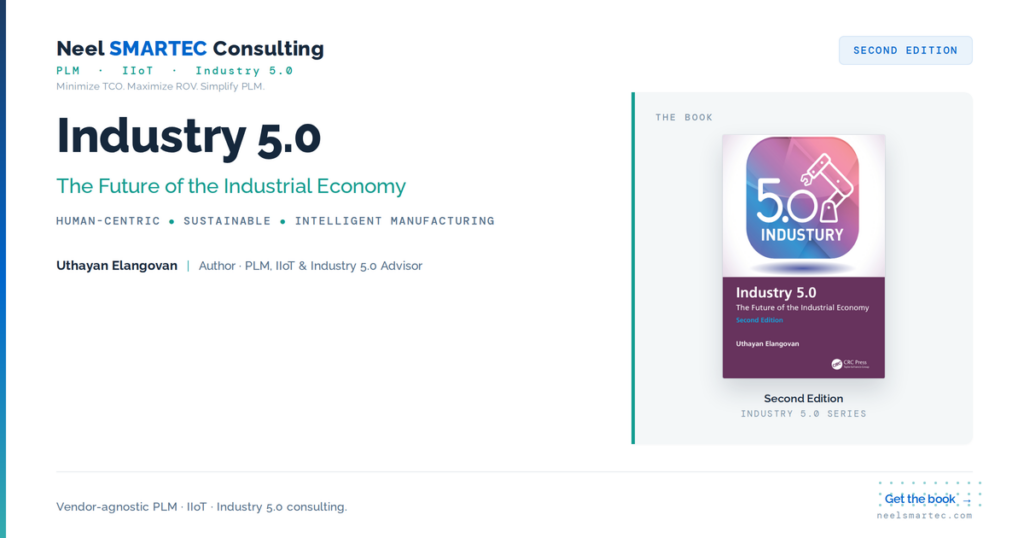
Industry 5.0: The Future of the Industrial Economy
The industrial landscape continues to evolve beyond digital transformation. Organizations are now expected to build manufacturing systems that are not only intelligent and connected, but also human-centric, sustainable, resilient, and ethically governed.
This expanded second edition brings together practical insights, strategic frameworks, and cross-industry perspectives to help manufacturing leaders navigate this next phase of transformation — with new chapters, updated technologies, and practical guidance for today’s priorities.
The second edition, in five facts
Technology adoption alone hasn’t solved manufacturing’s hardest problems
Manufacturing has made remarkable progress over the past decade. Organizations have invested in automation, digital engineering, IIoT, artificial intelligence, cloud platforms, and connected operations — improving efficiency, visibility, and productivity across the product lifecycle.
Yet many organizations continue to face familiar challenges. Digital initiatives often remain isolated within individual departments. Engineering, manufacturing, supply chain, and service teams still struggle to work with consistent, connected information, and technology investments don’t always translate into measurable business outcomes.
Industry 5.0 represents the next stage of industrial evolution. Rather than focusing solely on technology adoption, it emphasizes building manufacturing enterprises that balance technological innovation with human expertise, environmental responsibility, business resilience, and long-term value creation — building on Industry 4.0’s digital foundations rather than replacing them.
Every book has a story
For Industry 5.0: The Future of the Industrial Economy, that story began before the first edition was written — shaped by consulting engagements, academic workshops, and executive-level conversations across manufacturing.
Publication of PLM: A Digital Journey Using IIoT marked an important milestone. Following its recognition, CRC Press expressed interest in expanding the author’s contributions through future publications.
Conversations with manufacturing professionals, engineering leaders, and academic peers revealed a common challenge: practical guidance on turning digital investment into measurable business value. These discussions became the foundation for the first edition.
The journey continued through consulting engagements, Industry 5.0 workshops for academic institutions, and the development of the Handbook of Product Lifecycle Management (PLM) — reinforcing that leadership, workforce readiness, sustainability, and organizational change matter as much as technology.
A CXO-level Industry 5.0 consulting engagement further reinforced the importance of these strategic dimensions and the need for guidance that extends beyond technology implementation.
In July 2025, CRC Press invited the author to prepare a second edition. The manuscript was completed in December 2025 — expanding the original work with new chapters, updated technologies, and contemporary industry perspectives.
Updated for a rapidly evolving industrial landscape
The first edition introduced the principles of Industry 5.0 and explored how industrial transformation extends beyond technology adoption. Since then, artificial intelligence has become more accessible, sustainability has become a strategic priority, and organizations are increasingly expected to build operations that are resilient, human-centric, and responsibly governed. The second edition reflects these changes while preserving the practical approach of the original work.
Expanded coverage
- ✓Digital maturity as a foundation for transformation
- ✓AI copilots, cognitive systems, and intelligent manufacturing
- ✓Digital twins and emerging industrial technologies
- ✓Human-centric manufacturing and workforce empowerment
- ✓Sustainability and circular manufacturing principles
- ✓Industrial governance, ethics, and responsible innovation
- ✓Strategic planning for Industry 4.0 to Industry 5.0 transformation
Four new chapters
Human-Centric Design & Workforce Empowerment
How organizations can combine technology with human capabilities through ergonomics, digital assistance, workforce wellbeing, and collaborative environments.
Sustainability, Circular Manufacturing & Responsible Innovation
Practical approaches to integrating sustainability into product development, manufacturing operations, and lifecycle management.
Digital Maturity & Industrial Readiness
Practical frameworks to assess current capabilities, identify transformation gaps, and develop structured improvement roadmaps.
Policy, Governance & Ethics in Industry 5.0
Responsible technology adoption, AI governance, data ownership, traceability, and governance considerations for sustainable transformation.
Beyond the expanded content, the second edition includes updated examples, refined frameworks, and a Future Readiness Checklist for Industry 5.0 in the appendix — a practical tool to reflect on your organization’s preparedness for the next phase of industrial transformation.
A structured understanding of Industry 5.0
Organized to help readers build a structured understanding of Industry 5.0 — from the foundations of industrial transformation to practical implementation strategies. Rather than focusing on individual technologies, the book connects business strategy, engineering, manufacturing, people, and sustainability into a comprehensive transformation framework.
Understanding Industrial Transformation
Build a strong foundation by exploring the evolution of industrial transformation, engineering and manufacturing processes, and the technological journey from Industry 3.0 through Industry 5.0.
Learning from Industry Applications
Discover how Industry 5.0 concepts apply across manufacturing sectors through practical examples from automotive, high-tech electronics, and process and industrial manufacturing.
Building Future-Ready Manufacturing Enterprises
Explore the strategic capabilities required to lead Industry 5.0 initiatives — human-centric design, workforce empowerment, sustainability, circular manufacturing, digital maturity, governance, and responsible innovation — concluding with a practical roadmap from Industry 4.0 to Industry 5.0.
Throughout the book, technology is presented as an enabler of business transformation rather than an end in itself — the emphasis remains on measurable business value through connected processes, informed decision-making, and sustainable industrial practices.
Built to translate ideas into action
Beyond concepts and industry examples, the second edition includes practical resources designed to help readers reflect on their own transformation journey.
Future Readiness Checklist
Included as an appendix, this checklist helps readers evaluate whether their organization is prepared for the next phase of industrial transformation — across technology, people, processes, sustainability, governance, and business readiness.
Practical Frameworks
Structured approaches throughout the book that simplify complex transformation concepts into practical guidance for planning, implementation, and continuous improvement.
Cross-Industry Perspectives
Drawing from automotive, high-tech electronics, process manufacturing, and industrial manufacturing sectors, demonstrating how Industry 5.0 principles adapt across environments.
Strategic Thinking
Encourages readers to look beyond technology adoption toward leadership, organizational readiness, workforce empowerment, sustainability, and long-term resilience.
Written for anyone shaping the future of manufacturing
Industry 5.0 is not limited to a single function or discipline — it requires collaboration across business leadership, engineering, manufacturing, operations, and academia.
Manufacturing Executives & Business Leaders
Gain a strategic understanding of Industry 5.0 and align technology investments with business objectives, resilience, sustainability, and competitive advantage.
Engineering & Product Development Leaders
Explore how engineering processes, digital technologies, and lifecycle thinking support innovation while improving collaboration across the product lifecycle.
Manufacturing & Operations Professionals
Understand practical approaches to improving processes, adopting emerging technologies, and connecting engineering, production, quality, and supply chain.
Digital Transformation, PLM & Industry 4.0 Practitioners
Discover how Industry 5.0 builds upon existing initiatives by integrating people, processes, technology, and governance into a holistic strategy.
Consultants & Technology Advisors
Develop a broader perspective on industrial transformation, supported by practical frameworks and cross-industry examples.
Faculty, Researchers & Students
Build a strong foundation in Industry 5.0 through a balanced combination of concepts, technology trends, and real-world use cases.
A business transformation journey, not a technology initiative
Many books explain the technologies shaping modern manufacturing. This one focuses on something equally important — how organizations can apply those technologies to achieve meaningful and sustainable industrial transformation.
A Practitioner-Led Perspective
Informed by manufacturing consulting, executive-level Industry 5.0 engagements, and interactions across engineering, manufacturing, and business functions.
Cross-Industry Learning
Examples from automotive, high-tech electronics, process industries, and industrial manufacturing show how principles adapt to unique transformation journeys.
A Balanced View of Transformation
Explores how leadership, people, business processes, sustainability, governance, and digital capabilities work together for resilient enterprises.
Practical Rather Than Prescriptive
Introduces practical concepts, frameworks, and implementation considerations readers can evaluate and adapt to their own context.
Designed for Learning & Decision-Making
Supports informed decision-making and critical thinking, with a structured understanding of Industry 5.0 from strategic and operational perspectives.
Explore complementary publications
Industrial transformation is a continuous journey. While this book provides a strategic perspective on the future of manufacturing, these publications explore complementary areas of product lifecycle management, digital engineering, and smart manufacturing.
Smart Automation to Smart Manufacturing
Introduces industrial automation and the enabling technologies that support smart manufacturing.
Discover the Book →PLM: A Digital Journey Using IIoT
Examines how PLM and IIoT work together to create connected digital enterprises.
Learn More →Industry 5.0: The Future of the Industrial Economy
A strategic perspective on human-centric, sustainable, and resilient manufacturing.
Handbook of Product Lifecycle Management
A comprehensive reference exploring PLM from business strategy to implementation.
Together, these publications provide complementary perspectives — from smart manufacturing and product lifecycle management to Industry 5.0 — helping readers build a broader understanding of modern industrial transformation.
Common questions about the book
Yes. The book begins by explaining the evolution of industrial transformation and the progression from Industry 3.0 to Industry 4.0 and Industry 5.0 before exploring more advanced concepts.
No. While the book discusses technologies such as AI, digital twins, IIoT, and automation, the primary focus is on their business application within manufacturing.
Expanded discussions on emerging technologies, revised industry perspectives, four new chapters covering human-centric design, sustainability, digital maturity, and governance, plus a Future Readiness Checklist for Industry 5.0.
No. While it includes examples from automotive, high-tech electronics, process industries, and industrial manufacturing, the principles are intended to apply across a wide range of manufacturing sectors.
It combines foundational concepts with practical industry perspectives — explaining how organizations can approach transformation by aligning business strategy, engineering, manufacturing, people, and sustainability.
Manufacturing executives, engineering and operations leaders, digital transformation professionals, consultants, faculty, researchers, and students seeking a structured understanding of Industry 5.0.
Yes. In addition to frameworks throughout the chapters, the appendix includes a Future Readiness Checklist for Industry 5.0 to help readers reflect on organizational preparedness.
Yes. It’s designed to support both academic study and professional development, combining industrial concepts, practical examples, and strategic perspectives.
Begin your Industry 5.0 journey today
Manufacturing continues to evolve at an unprecedented pace. Organizations are expected to embrace technological innovation while strengthening collaboration, developing future-ready workforces, improving sustainability, and building resilient business models.
Whether you’re defining your organization’s transformation strategy, modernizing engineering and manufacturing operations, or preparing for the next generation of industrial innovation, this book offers a structured perspective on navigating the opportunities and challenges of Industry 5.0.
Purchase Industry 5.0: The Future of the Industrial Economy
Available from CRC Press and leading online booksellers. Bring together practical insights, strategic frameworks, and cross-industry perspectives for your organization’s next phase of transformation.