
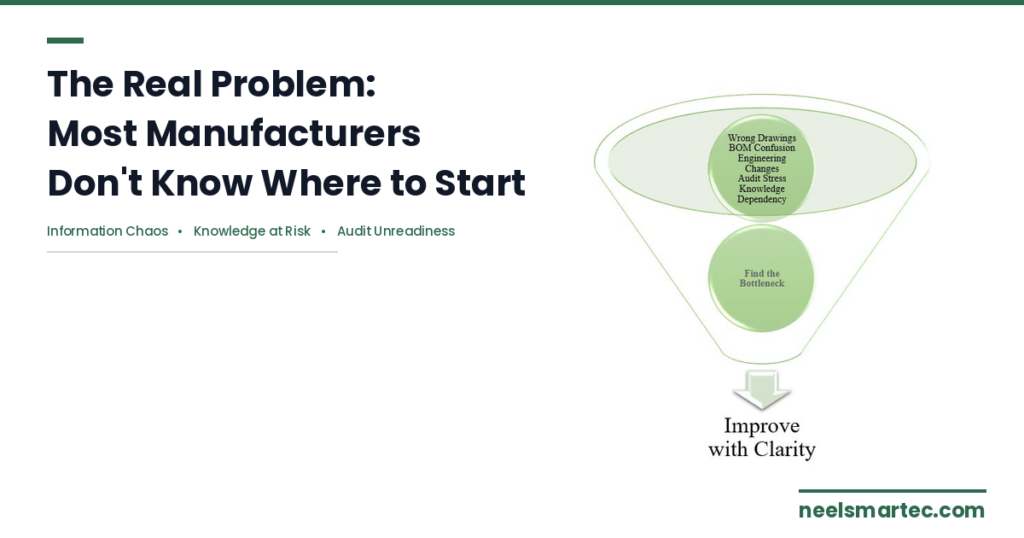
The Real Problem: Most Manufacturers Don’t Know Where to Start
Most manufacturing leaders know when something is not working as it should.
- Projects take longer than expected.
- Engineering changes create confusion.
- Teams spend too much time searching for information.
- Customer audits create unnecessary stress.
- People work hard, yet the same problems seem to return.
The challenge is that these issues rarely appear as one obvious problem. Instead, they show up as dozens of small frustrations spread across engineering, quality, manufacturing, procurement, and operations.
Which is the latest version of the drawing?
Why is production using a different BOM?
Who approved this engineering change?
Where is the customer-approved specification?
Has purchasing received the latest information?
Why are we discussing this issue again?
Why does audit preparation always become a last-minute exercise?
Individually, these questions seem manageable. Collectively, they slow down the entire business.
The Problem Is Rarely Lack of Effort
Across many manufacturing environments, I have observed a common pattern. The issue is rarely that people are not working hard.
Most teams are doing everything they can to meet customer expectations, launch products on time, solve quality issues, and support production. The real challenge is understanding where effort is being lost.
When information is difficult to find, decisions slow down. When decisions slow down, teams create workarounds. Over time, those workarounds become the process.
That is when operational bottlenecks begin to develop.
It Often Starts During NPD and NPI
Many of these bottlenecks can be traced back to New Product Development (NPD) and New Product Introduction (NPI).
A new product is designed. Drawings are revised. Parts are added or changed. Suppliers receive updates. Production prepares for launch. Quality documentation is created. Customer requirements evolve. Each step introduces new information. Each change introduces new risk.
At first, everything appears manageable. Then information starts moving through multiple channels:
- Excel
- Shared folders
- Verbal discussions
- Individual notebooks
Soon, people begin asking: Which drawing is correct? Which BOM should we use? Has everyone been informed about the latest change? Who owns this decision?
The challenge is not complexity. The challenge is maintaining clarity as complexity grows.
For a deeper discussion on this topic, see: When PLM Becomes Just a Document Shelf.
Every Manufacturer Has Bottlenecks
The challenge is knowing which one matters most. Many improvement initiatives struggle because organisations try to solve everything at once — more software, more reports, more meetings, more dashboards — yet the real constraint remains hidden.
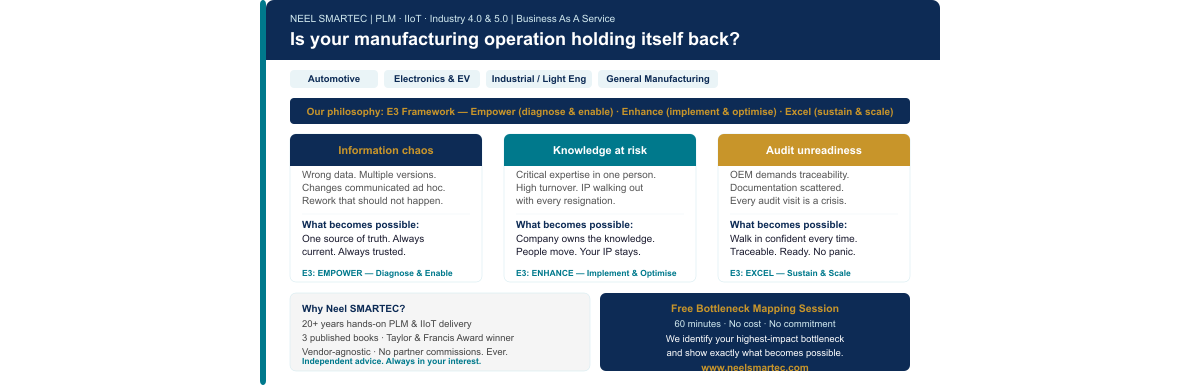
In my experience, most operational bottlenecks fall into three categories.
People cannot easily find trusted information. Multiple versions exist. Teams work from different assumptions. Engineering, manufacturing, quality, and procurement become misaligned. The result is confusion, rework, delays, and avoidable cost.
Critical knowledge exists inside the heads of a few individuals. One engineer knows the history. One quality manager understands the customer requirements. One supervisor knows how things really work. When those individuals are unavailable, progress slows. The business becomes dependent on people rather than process.
Documentation exists. Traceability exists. But finding the right information takes too much effort. Every audit becomes a document-hunting exercise. The audit itself is not the problem — the audit simply exposes weaknesses that already exist.
Why Improvement Initiatives Often Stall
Many manufacturers recognise these symptoms. What they struggle with is deciding where to begin.
Should we improve our processes? Should we implement PLM? Should we upgrade ERP? Should we invest in automation? Should we explore AI? These are reasonable questions. However, there is a risk in choosing solutions before fully understanding the problem.
Technology can accelerate improvement. It cannot create clarity where none exists.
Without understanding the true bottleneck, organisations often spend time and money solving symptoms rather than causes.
If you are evaluating PLM as part of your improvement journey, you may find these articles useful:
Finding the Constraint Before Choosing the Solution
The first step is not selecting software. The first step is understanding where the business is constrained.
- Where does information slow down?
- Where do decisions wait for one person?
- Where do engineering changes create confusion?
- Where does traceability break down?
- Where does rework originate?
- Where are teams spending time searching rather than executing?
Once the highest-impact bottleneck becomes visible, the path forward becomes much clearer. Sometimes the answer is process improvement. Sometimes it is better information management. Sometimes it is organisational alignment. Sometimes technology becomes part of the solution.
The important thing is understanding the problem before investing in the solution.
Clarity Before Action
The companies that improve fastest are not always the ones investing the most money. They are the ones that gain clarity first.
They understand where effort is being lost. They identify the bottleneck creating the greatest impact. Then they focus their improvement efforts accordingly.
Every manufacturer has bottlenecks. The challenge is knowing which one matters most.
Most operational issues eventually fall into one of three categories. The challenge is identifying which bottleneck is creating the greatest impact in your organisation.
Not Sure Where to Start?
If you are looking for a structured starting point, here are three options.