The hidden bottlenecks choking SME growth, and why Product Lifecycle Management is the missing layer most never consider.
Picture a small manufacturer with a full order book. Business is growing. The team is working hard. And yet, deliveries keep slipping. Engineering changes get lost in email threads. The wrong version of a drawing reaches the shop floor. A BOM error discovered at assembly costs three days and a customer relationship.
Sound familiar? The instinct is to blame people, process, or culture. The real culprit is almost always invisible: a missing layer of infrastructure between how a product is designed and how it is built.
That missing layer has a name. It’s called Product Lifecycle Management (PLM). And for most SME manufacturers, it’s the tool they’ve never heard of, but desperately need.
The SME Trap: Busy, But Broken
Small and mid-sized manufacturers operate in a perpetual juggle. Sales are chasing new business while engineering is firefighting change requests, production is waiting on drawings, and quality is scrambling for traceability when a customer audit lands.
The root cause of this chaos usually isn’t a lack of effort. It’s a structural gap in how product information flows or fails to flow through the organisation.
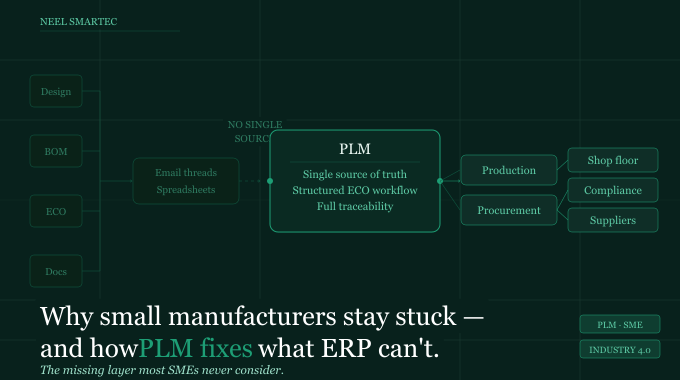
Here’s what that looks like in practice: the Bill of Materials lives in spreadsheets, with multiple versions in circulation and no single source of truth. Engineering change orders are approved over email, informally, with no traceable record. Drawings sit on shared drives with no version control. Suppliers are working off specs that were updated three revisions ago.
Each of these is a bottleneck on its own. Together, they compound into a system that slows growth, erodes margins, and makes scaling deeply painful.
What ERP Gets Wrong and Was Never Meant to Fix
Most SMEs that have invested in infrastructure have an ERP system. And ERP is genuinely powerful — for managing transactions, inventory, financials, and procurement. But ERP was designed around what happens after a product is defined. It manages the execution of a product, not the product itself.
ERP tells you what to build. PLM governs how it was designed, how it changed over time, and who approved what and when.
The gap between these two worlds is where most SME problems live. Cost overruns, late deliveries, quality escapes, trace them back far enough and you’ll almost always find a breakdown in product data, not in execution.
PLM: The Layer Most SMEs Don’t Know They Need
PLM is the system of record for your product. It manages the full lifecycle, from early concept through engineering, manufacturing, and even end-of-life. In practice, for an SME, this means structured management of your BOMs, drawings, engineering change orders, compliance documents, and supplier data — all in one controlled environment.
For decades, PLM was the domain of large aerospace, automotive, and defence manufacturers. Platforms like Windchill from PTC required significant investment and specialist implementation teams. The perception, understandably, was that PLM wasn’t for smaller organisations.
That perception is now outdated. Cloud-based and SaaS PLM options have fundamentally changed the economics. Right-sized implementations for teams of 10 to 200 engineers are not only possible — they are increasingly common.
Real Bottlenecks PLM Directly Addresses
Engineering change chaos → Structured ECO workflows. Every change request follows a defined path: initiated, reviewed, approved, and released. No more change decisions are made in WhatsApp groups and forgotten.
Multi-version BOM confusion → Single source of truth. One revision-controlled BOM that everyone — engineering, production, and procurement works from. The wrong version simply doesn’t exist anymore.
Compliance and audit readiness → Built-in traceability. When a customer or regulatory audit arrives, your documentation trail is already there. Not assembled in a panic over a weekend.
Supplier collaboration gaps → Controlled data sharing. External partners receive the right version of the right document, automatically. No more “which drawing did you get?” conversations.
Document version sprawl → Centralised control. Every drawing, specification, and procedure lives in one place, with access governance, version history, and approval records intact.
Busting the “Too Expensive, Too Complex” Myth
This is the objection I hear most often from SME leaders. And it made sense ten years ago. Today, it simply isn’t true.
Cloud PLM can be deployed incrementally, starting with one product line or one pain point, in a matter of weeks, not years. Subscription pricing has replaced six-figure licence fees. And a right-sized implementation, guided by someone who understands both the technology and the realities of manufacturing operations, doesn’t require an army of consultants.
The critical point: there is no single right PLM tool. The right answer depends on your team size, your sector, your existing systems, and your growth plans. A vendor-agnostic evaluation, one not driven by partner incentives or referral commissions, consistently delivers better outcomes than being steered toward whichever platform a systems integrator happens to resell.
Where to Start! Without a Big-Bang Project
The biggest mistake manufacturers make when approaching PLM is trying to solve everything at once. A big-bang implementation is expensive, slow, and demoralising when it stalls. The smarter approach is to start with one pain point, prove the value, and expand.
For most SMEs, the best entry points are document control and BOM management. These deliver immediate, visible relief and they create the foundation for everything else to follow: change management, compliance, supplier collaboration, and integration with ERP.
You’re ready for PLM if you’re experiencing three or more of these:
- Engineering changes regularly reach the shop floor late or incomplete
- More than one “master” BOM is in circulation at any time
- Audit preparation takes weeks rather than hours
- New engineers spend excessive time finding the right document revision
You don’t need a perfect plan. You need a starting point and a guide who understands both the technology and the realities of your operations.
The Bottom Line
Growth should not feel like it’s working against you. If your team is skilled and your order book is full, but the organisation still feels stuck, the bottleneck is almost certainly in how product knowledge is managed, not how hard people are working.
PLM is not a luxury for large enterprises anymore. It is increasingly the foundation on which mid-market manufacturers build the operational rigour they need to scale with confidence.
The question isn’t whether you need it. The question is where to start.
Is your organisation ready for PLM?
If you recognised three or more bottlenecks in this article, let’s have a no-obligation conversation. Neel SMARTEC provides vendor-agnostic PLM advisory; we recommend what fits your business, not what earns a referral fee.
Book a free discovery call · Explore our services
Planning a PLM or Digital Transformation Initiative?
Discuss your roadmap priorities, engineering data challenges, or PLM readiness gaps with Neel SMARTEC.
Schedule a Strategy Discussion