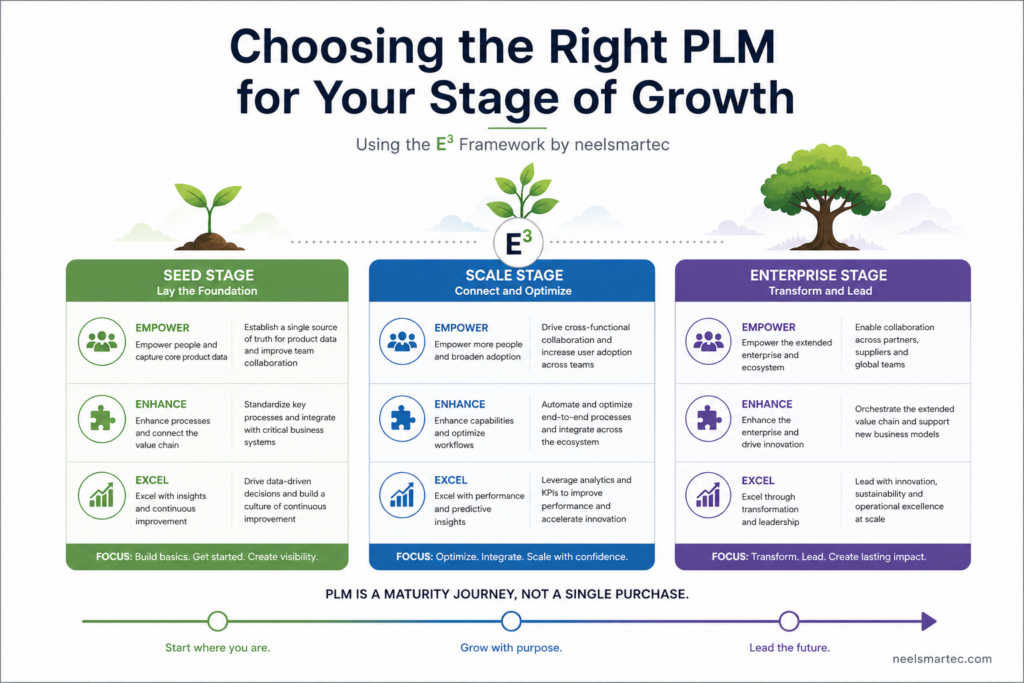
Choosing the Right PLM for Your Stage of Growth
Every few months, I speak with a manufacturer who has invested significantly in a PLM platform — and is still running product data in Excel. The tool works. The adoption does not. When I dig into why, the answer is almost always the same: they chose a tool for the company they wanted to be, not the company they actually are.
PLM selection is not a feature comparison exercise; it is a growth-stage decision. Choosing a tool that is ahead of your organisational readiness does not accelerate your transformation — it compounds your existing problems.
| Stage | Data Reality | The Primary “Pain” | Strategy |
|---|---|---|---|
| 1. Seed | Excel, Email, Local Drives | “Where is the latest BOM?” | Establish a Single Source of Truth. |
| 2. Scale | Multi-site, ERP links | “Why is this ECO taking weeks?” | Build the Process Foundation. |
| 3. Enterprise | Global, MES, IIoT | “How do we upgrade without breaking?” | Master the Integration Architecture. |
The wrong question manufacturers are asking
Most PLM selection processes begin with: “Which tool is best?”
The more useful question is: “Which tool is right for where we are now?”
A tool that is best-in-class at Enterprise scale will overwhelm a 10-person engineering team. Choosing wrong in either direction is expensive — not just in licence fees, but in the adoption capital you burn when teams route around a system that doesn’t fit.
Before looking at vendors, ensure your project aligns with our Industrial Transformation Framework. PLM is not just a system; it is a transformation that requires Phase 1: Empower (Readiness and Alignment) to be completed before any software is installed.
The three growth stages — and what they actually look like
1. Seed stage — Structured chaos
At the Seed stage, product data is person-dependent rather than system-dependent. The priority is establishing a source of truth that the team will actually use without being buried in administrative overhead.
Tools to evaluate: OpenBOM, Onshape PDM, Propel (SaaS).
2. Scale stage — Complexity catching up
BOM complexity has increased, and Engineering Change Orders (ECOs) are becoming a bottleneck. The priority is a system that handles formal change management and provides multi-site visibility for procurement and manufacturing.
Tools to evaluate: Windchill Essentials, Teamcenter X, Arena PLM, Propel.
3. Enterprise stage — Integration is the challenge
At this scale, success depends on the integration architecture across PLM, ERP, MES, and IIoT. The focus shifts to long-term data portability and the governance required to maintain a global ecosystem.
Tools to evaluate: PTC Windchill, Siemens Teamcenter, SAP PLM, Dassault ENOVIA.
The TCO iceberg — what vendors won’t show you
Licence costs typically represent only 20% to 30% of the real five-year Total Cost of Ownership (TCO). In our Industry Publications, we frequently discuss how the “hidden” costs of fragmented data—rework, delays, and engineering time lost to data management—dwarf the software price tag.
- Data Migration: Usually the most underestimated technical hurdle.
- Integration Development: Connecting CAD, ERP, and MES.
- Change Management: The factor that determines whether your team adopts the tool or reverts to Excel.
Not sure of your current overhead? Use the Engineering Data Cost Diagnostic to quantify these hidden costs in minutes.
The Neel SMARTEC Selection Logic
- Audit the “Now”: Don’t automate a mess. Clean your data and processes first.
- Identify the “Stage”: Seed, Scale, or Enterprise? Match the tool to your current maturity level.
- Assess the “Iceberg”: Budget for implementation, migration, and training—not just seats.
- Apply the E3 Framework: Follow the path from Empower (Preparation) to Enhance (Optimisation) and finally Excel (Scale).
Once you have chosen — what comes next
Tool selection is only the beginning. The first 90 days of your implementation will determine the trajectory of the entire project. We have mapped out a specific 90-Day PLM Roadmap to help you navigate the transition from legacy spreadsheets to a digital-first environment.
Not sure where you sit?
At Neel SMARTEC, we are vendor-agnostic by principle. We receive no commissions from software providers, ensuring our recommendations are based purely on what fits your business, your team, and your budget.
Take the PLM Readiness Assessment →
Planning a PLM or Digital Transformation Initiative?
Discuss your roadmap priorities, engineering data challenges, or PLM readiness gaps with Neel SMARTEC.
Schedule a Strategy Discussion