AI · Manufacturing · PLM
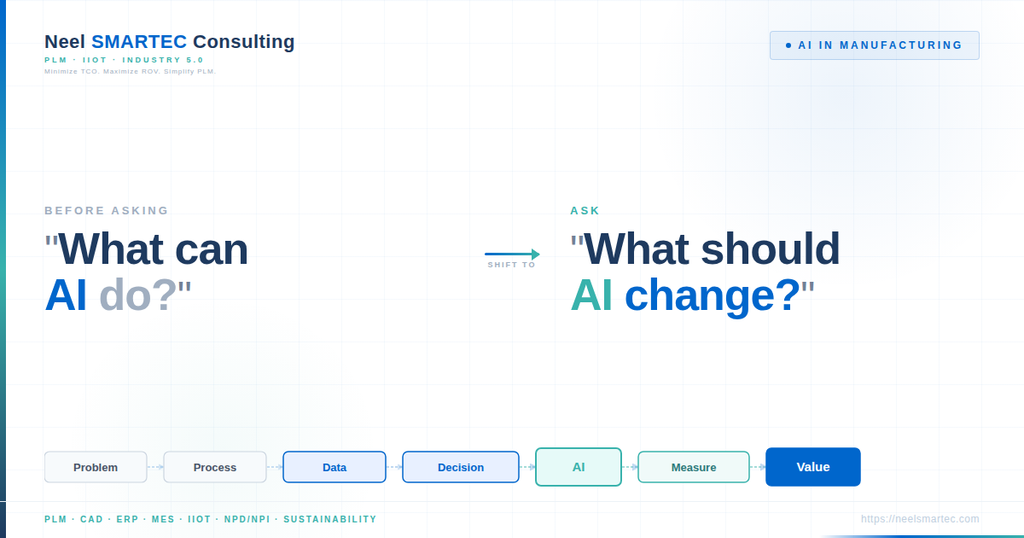
AI in Manufacturing: Before Asking What AI Can Do, Ask What It Should Change
AI is everywhere in manufacturing conversations today. The harder question isn’t where AI could go — it’s what should actually change once it’s there.
AI in CAD. AI in PLM. AI in ERP. AI in MES. AI in IIoT. AI for NPD and NPI. AI for quality. AI for maintenance. AI for sustainability.
And somewhere in the middle of all these conversations, I keep hearing a similar statement from manufacturing leaders, engineers, NPD/NPI teams and PLM professionals:
“We want AI in our work.”
I don’t think there is anything wrong with that statement. In fact, it is understandable.
Management is asking how the organisation can adopt AI. Teams are being asked to identify AI opportunities. Software vendors are demonstrating AI capabilities. Competitors are talking about AI. There is pressure to show that the organisation is not being left behind.
The difficult question comes a little later:
What exactly should AI change?
That is where the conversation sometimes becomes less clear.
A team may say they want AI in PLM. Another may ask for AI in CAD. Someone else may want an AI assistant for ERP or MES. A plant may want AI on IIoT data. An NPD team may want AI to help with product development.
All of these may be valid opportunities. But none of them, by themselves, explain the business problem.
Perhaps we need to step back before talking about the technology.
Start with the problem, not the AI
Suppose an engineering team spends a significant amount of time looking for previous designs, specifications, test reports or lessons learned.
The immediate reaction could be:
“Let’s use AI.”
But the more useful question is:
“Why are engineers spending so much time searching?”
- Is the information difficult to find?
- Is it stored across multiple systems?
- Is the product structure incomplete?
- Are documents poorly classified?
- Are engineers unsure which information is current?
- Is knowledge sitting with a few experienced people?
- Or is the process itself unnecessarily complicated?
AI may help. But the answer could also involve better information management, process changes, integration, automation or simply making existing capabilities easier to use.
This distinction matters.
If we start with AI, we tend to look for a place to put AI. If we start with the problem, we can decide whether AI is actually the appropriate answer.
That is a very different starting point.
The same situation exists across manufacturing
Consider NPD and NPI.
An organisation may have difficulty meeting product launch dates. Engineering changes continue late into the project. Manufacturing finds issues during introduction. Suppliers receive changes late. Different teams work with different versions of information.
Someone may suggest:
“Can AI improve NPI?”
Perhaps. But before discussing an AI solution, we need to understand where the delay actually occurs.
- Is it requirements?
- Design?
- Engineering review?
- Change management?
- BOM readiness?
- Supplier communication?
- Manufacturing readiness?
- Quality?
- Decision-making?
The same thinking applies to ERP. If planners are struggling with inventory, the question should not simply be:
“Can AI improve planning?”
It should be:
“What is causing the planning problem, and what decision needs to improve?”
The same applies to MES and manufacturing operations. If production performance is inconsistent, AI may help identify patterns or predict problems. But first we need to understand what information is available, what decisions are currently being made and what happens after an anomaly is identified.
And IIoT provides another good example. A company can collect enormous amounts of machine data and still struggle to create business value from it. The important question is not:
“How much machine data do we have?”
It is:
“What decision can we make better because we now have this data?”
That is where AI starts becoming meaningful.
Perhaps 5W1H is still one of the simplest ways to think about AI
We often use 5W1H for projects, investigations and problem solving. I think it works equally well for AI.

The 5W1H framework applied to AI in manufacturing.
Start with Why. Why do we need AI? What problem are we trying to solve? What is currently costing time, money, quality, productivity or customer satisfaction? What would we like to improve?
Then ask What. What exactly should AI do? Should it search information, identify patterns, predict an outcome, recommend an action, generate content, detect an anomaly or automate part of a process? These are very different capabilities.
Then ask Where. Where does the problem actually occur? It may be in CAD, PLM, ERP or MES. But increasingly, the opportunity may be between these systems.
A product moves from engineering to manufacturing and eventually into operations and service. Information moves with it, although often imperfectly.
A design decision can affect the BOM. The BOM can affect ERP planning. Manufacturing information can reveal a quality problem. Quality information can reveal a design issue. Service information can provide valuable feedback for the next product.
So the opportunity for AI may not belong to one application. It may exist across the flow from engineering to operations.
Then comes Who. Whose work or decision will change? An engineer, planner, quality engineer, manufacturing engineer, PLM team, plant manager or business leader may all have very different expectations from AI.
For an engineer, reducing the time spent searching for information may be valuable. For a plant manager, improving production predictability may matter more. For a business leader, improving launch performance or reducing working capital may be the real objective.
The AI capability may be the same technology, but the business value is different because the decision is different.
Then there is When. When should AI be introduced? This is an important question because not every process is ready for AI.
- If the underlying information is unreliable, AI may produce unreliable results.
- If the process is unclear, AI may simply make a poor process faster.
- If data ownership is not established, people may not trust the result.
- If information is spread across systems, AI may only see part of the picture.
This does not mean an organisation has to digitise everything before using AI. That would be unrealistic.
It means that each AI opportunity needs a practical assessment of the process, information, systems and people involved.
Sometimes AI is the right next step. Sometimes improving the data is the right next step. Sometimes process simplification or normal automation is enough.
Knowing the difference is part of AI readiness.
Finally, ask How. How will we know whether the AI initiative worked? This is where the business case becomes real.
If engineers currently spend two hours searching for information, can that become 20 minutes? If an engineering change currently takes five days to complete, can it be reduced? If a product launch is regularly delayed because of late information, can that delay be reduced? If a plant is losing production time because of recurring equipment issues, can those issues be identified earlier? If energy consumption is higher than expected, can the organisation identify the causes and act on them?
These are measurable questions.
“Implement AI” is not a measurable outcome.
- “Reduce engineering search time by 50%” is.
- “Improve NPI readiness before production release” is.
- “Reduce avoidable downtime” is.
- “Reduce material waste” is.
That is how AI starts moving from a technology discussion to a business discussion.
What does this mean for PLM?
I find this particularly interesting in PLM.
PLM contains much of the context behind a product: requirements, designs, parts, BOMs, specifications, documents, changes, configurations, approvals and product history.
That context can make AI much more useful.
But I don’t think the biggest opportunity is simply to say:
“Let’s put AI into PLM.”
The more interesting question is:
“How can AI use trusted product information to help people make better engineering and business decisions?”
That changes the conversation. It moves AI from being another feature in an application to becoming part of the way an organisation uses its product knowledge.
The same principle applies to CAD, ERP, MES and IIoT.
The technology matters. But the technology should serve the decision.
Sustainability should be part of the same conversation
Sustainability is another area where organisations can easily fall into the same trap.
It is tempting to say:
“We need AI for sustainability.”
But what does that mean?
- Perhaps the organisation wants to reduce energy consumption.
- Perhaps it wants to reduce scrap.
- Perhaps it wants to improve material utilisation.
- Perhaps it wants better visibility of product lifecycle impact.
- Perhaps it wants to make better design decisions.
These are different problems.
A product’s environmental impact may be influenced by decisions made much earlier in its lifecycle — during requirements, design, material selection and manufacturing planning.
AI can potentially help identify patterns, compare alternatives and support decisions. But again, the starting point should be the outcome we want to improve — a way of thinking about people, technology and sustainability together, not in isolation.
And this thinking is not limited to manufacturing
The same questions can be applied almost anywhere.
Education is a good example. Instead of asking:
“How can we use AI in education?”
we can ask:
The domain changes. The thinking does not.
That is why I believe AI literacy should not be limited to understanding AI tools. People also need to understand where AI fits into a problem, a process and a decision.
Perhaps the biggest change we need is in the question we ask
Manufacturing organisations do not necessarily need another long list of AI use cases.
They need to understand which problems are worth solving, where those problems occur, what information is available, who owns the decision and how improvement will be measured.
AI can then become one of the possible ways to solve the problem.
Not every problem needs AI. Not every AI capability creates business value. And not every AI project needs to be large.
A small, well-defined problem with a measurable outcome can teach an organisation much more than a large AI programme launched simply because everyone else is talking about AI.
So before asking:
“Where can we use AI?”
perhaps we should ask a simpler question:
“What would we like to be different after we use AI?”
That question brings the discussion back to where it should start: the business, the process, the people and the value.
And only then, AI.
Planning a PLM or Digital Transformation Initiative?
Discuss your roadmap priorities, engineering data challenges, or PLM readiness gaps with Neel SMARTEC.
Schedule a Strategy Discussion