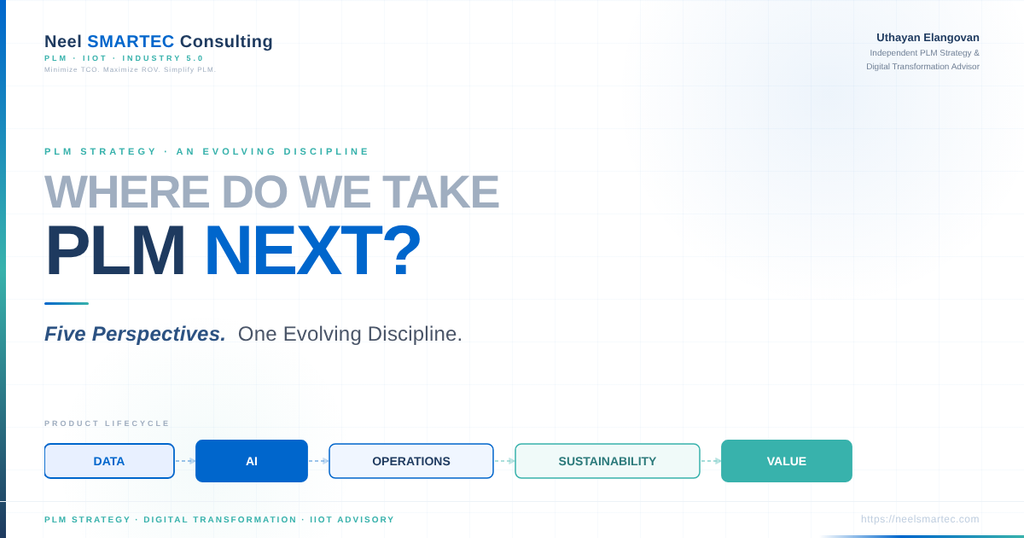
The question of the future of PLM is becoming more interesting as products, engineering processes, AI, connected systems, and sustainability become increasingly interconnected.
Where Do We Take PLM Next?
A weekend conversation with my college mate recently took me somewhere I didn’t expect. We were discussing my recent blog on AI in Manufacturing. My college mate Annamalai, an electrical engineer (Joint Chief – Engineering at Central Electricity Regulatory Commission (CERC)), raised a question that sounded simple at first: why does AI require so much electrical power?
His concern was practical. As AI workloads increase, data centres need much more computing capacity, which means more power and, inevitably, more heat to manage.
That took our conversation beyond AI itself.
We started talking about GPUs and computational power, then about the heat generated by computing systems. Somehow, the discussion moved back to the computers we used in the late 1990s. I still remember the sound of the fans in desktop computers around 1998–99 as processing requirements increased.
From there, the conversation moved naturally to something much bigger: how data-centre racks need to be designed to handle computing, power, and cooling, and eventually how all of this connects to the capacity and reliability of the electrical grid supporting them. What began as a conversation about AI power consumption had suddenly become a conversation about an entire ecosystem.
That made me pause.
This is how many technology conversations actually evolve in industry. We start with one technology or one business problem, and before long we discover that it is connected to several other layers of engineering, infrastructure, people, processes and decisions. It also made me think about five different perspectives on PLM that I recently brought together in Chapter 10 of my Handbook of Product Lifecycle Management. At first, these perspectives may appear quite different: sustainability, strategy and mindset, people-process-data, continuous transformation and digital twins. But perhaps they are not five separate perspectives at all. Perhaps they are different ways of looking at the same underlying reality: a product does not exist in isolation. Its lifecycle is connected to the decisions, systems, infrastructure, people and resources around it.
And that brings us to a bigger question: Where do we take PLM next?
One technology decision rarely stays within one technology
The more we talked about it, the more interesting the conversation became. The question was no longer simply how much power an AI model consumes. We started looking at what sits around the computing itself. More computation means different requirements for hardware, cooling, rack design, and data-centre infrastructure. Those requirements have implications for the facilities that support them, and ultimately for the energy infrastructure needed to keep the whole system operating reliably. In other words, the technology cannot really be separated from the environment in which it operates. That is not unique to AI. A similar pattern exists throughout manufacturing. A decision made during product design can influence manufacturing processes, material requirements, sourcing, quality, service, and eventually the customer’s experience. A manufacturing constraint can lead back to engineering; similarly, a field problem can trigger a design change. A sustainability requirement can influence material selection, supplier decisions, and even how a product is designed for its eventual end of life.
Once you start looking at the lifecycle this way, the boundaries between functions become less obvious. So, I find PLM such an interesting and evolving discipline, and is often discussed through the views of software, systems and product data. Those are certainly important, but the real product lifecycle is much larger than the system that happens to manage part of it.
The product moves through an ecosystem. Engineering defines the product and its requirements, while manufacturing turns those requirements into something physical and suppliers contribute materials and components. Customers generate experience and feedback, while service creates another layer of knowledge. The challenge is which connections create value, for whom, and at what point in the lifecycle?
Five Perspectives on the Future of PLM
That question brings me back to the five perspectives I encountered while working on Chapter 10 of my Handbook of Product Lifecycle Management. When I first brought them together, they looked like five different ways of thinking about PLM. Looking at them again through the lens of that weekend conversation, I see something different.
They are five ways of looking at how the product lifecycle is changing.
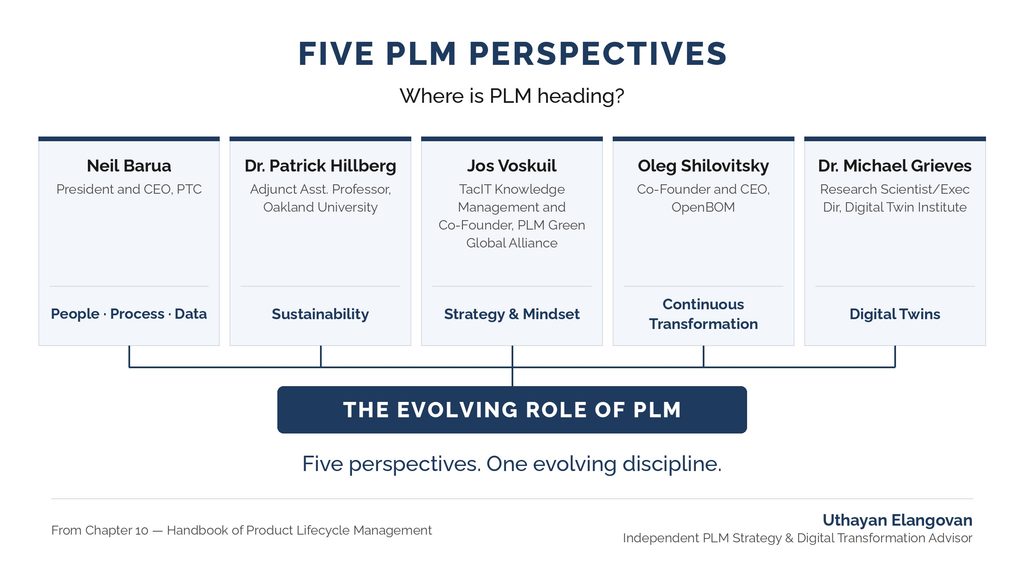
That weekend conversation also made me look again at five perspectives on PLM that I recently explored in a Medium article, based on Chapter 10 of my Handbook of Product Lifecycle Management. Five Perspectives on Where PLM Is Heading. What struck me was how different the perspectives initially appeared: Patrick Hillberg of Oakland University brings sustainability into the lifecycle conversation; Jos Voskuil of TacIT looks at PLM through strategy and mindset; Neil Barua of PTC emphasises the connection between people, processes and data; Oleg Shilovitsky of OpenBOM sees PLM as a journey of continuous transformation; and Michael Grieves brings digital twins into the picture. Yet when I put these perspectives alongside our conversation about AI, computing, data centres and power infrastructure, they began to feel less like five separate views and more like pieces of the same picture. Each perspective extends the boundaries of what we consider when we talk about the product lifecycle, and together they raise a more fundamental question: if the product lifecycle is becoming increasingly connected to the wider industrial ecosystem, where do we take PLM next?
The Boundaries of PLM Are Changing
Perhaps the biggest change is not happening inside PLM itself, but around it. The boundaries of the product lifecycle are becoming harder to define. A product is no longer only the physical thing that moves from design to manufacturing and then to the customer. It is increasingly connected to software, data, suppliers, manufacturing systems, service environments, sustainability requirements and the infrastructure needed to support it. The same is happening with the technologies we are bringing into the lifecycle. AI is one example. It can influence how we design, analyse, manufacture, service and make decisions about products, but it also brings its own requirements around computing, data, energy, infrastructure and skills. This is why I believe the next conversation about PLM should not begin with another question about which technology to add. It should begin with a more fundamental question:
What does the business need its product lifecycle to become?
For one manufacturer, that may mean better control of engineering changes and configuration. For another, it may mean connecting engineering decisions with manufacturing execution. Someone else may be trying to understand how product data can support service, sustainability or digital-twin initiatives. The technology choices will be different, but the underlying challenge is similar: creating a product lifecycle capability that can respond to the way the business actually operates and the way its products are evolving.
That is where I see the next phase of PLM moving. Not simply from one PLM system to another, and not simply by adding AI, digital twins or another layer of technology, but by thinking more deliberately about capability, connectivity and value across the lifecycle. The technology matters, but the bigger question is whether the organisation can turn what it knows about its products into better decisions and better outcomes.
From PLM software to PLM capability
For many years, PLM conversations have naturally centred around systems: which platform to select, how to implement it, how to migrate data and how to integrate it with the surrounding enterprise landscape. Those questions remain important, but I think the conversation now needs to move one level higher. Before asking which PLM technology an organisation needs, we should understand what capability the business actually needs. How mature are its product development processes? How effectively is product information managed? Where do engineering changes create downstream problems? Where are people still depending on spreadsheets, emails or manual workarounds? Without understanding these fundamentals, adding technology can sometimes make an existing problem more sophisticated without actually solving it.
From product data to lifecycle intelligence
The value of PLM also changes when we stop looking at product data as something that simply needs to be stored and start asking what that information can help the organisation understand. Engineering defines what needs to be built, manufacturing provides evidence of what was actually produced, service captures customer experience, and connected products increasingly provide information from the field. When these sources of information can be brought together meaningfully, the organisation can begin to learn from the lifecycle rather than simply manage it. This is where the conversation moves towards engineering-to-operations, digital threads and digital twins. The opportunity is to make the right information available to the right people when it can influence a decision.
From implementation to continuous value
Another shift is how we think about the end of a PLM initiative. Going live should not be the finish line. A system can be technically implemented and still fail to create the expected business value if people do not adopt it, processes remain fragmented or the organisation never measures whether the capability is actually improving outcomes. Products change, organisations change and business priorities change. PLM therefore needs to be treated as an evolving capability rather than a project that is completed and handed over. The question after implementation should not simply be whether the system is running, but whether the organisation is getting more value from the product lifecycle.
From technology adoption to intelligent and sustainable transformation
AI, digital twins, connected products and Industry 5.0 are changing the possibilities around PLM, but technology by itself does not determine the outcome. The AI conversation that started my weekend discussion with Annamalai is a good example. We began with computational power and ended up talking about cooling, data-centre design, electricity infrastructure and the wider ecosystem supporting it. That is exactly why sustainability, people, processes, technology and business value cannot be treated as separate conversations. The next generation of PLM will need to consider not only what technology can do, but also what resources it consumes, how people interact with it, how decisions change because of it, and what value it creates across the lifecycle.
So, where do we take PLM next? We take PLM toward a more connected understanding of the product lifecycle, where engineering decisions, product data, operations, people, sustainability and business value are considered together. The real opportunity allows us to understand what needs to be connected, why it is required, and how that connection creates value.
That, to me, is where the next chapter of PLM begins.
Planning a PLM or Digital Transformation Initiative?
Discuss your roadmap priorities, engineering data challenges, or PLM readiness gaps with Neel SMARTEC.
Schedule a Strategy Discussion