
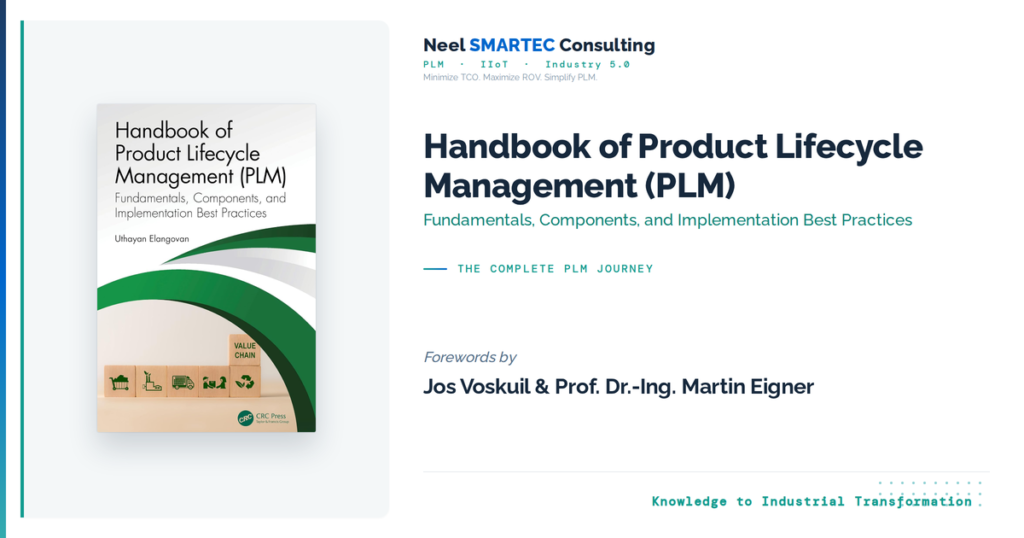
Handbook of Product Lifecycle Management
PLM has evolved from an engineering support system into a strategic business capability that connects people, processes, and technology across the entire product lifecycle. As organizations accelerate digital transformation, the need for a structured, vendor-neutral approach to PLM has never been greater.
Written from a practitioner’s perspective, this handbook combines implementation experience with proven principles covering business strategy, digital processes, technology, implementation best practices, Industry 5.0, and PLM economics — a practical reference for transforming knowledge into measurable business value.
More than selecting the right software
Every successful PLM initiative starts with more than selecting the right software. It begins with understanding business objectives, defining governance, aligning engineering and manufacturing processes, and preparing the organization for change — the factors that often determine whether a PLM initiative delivers lasting business value or falls short of expectations.
Throughout my experience working on PLM strategy, implementation, upgrades, and digital transformation initiatives, I repeatedly observed that successful PLM programs require organizations to connect business strategy, engineering processes, technology, governance, and organizational change. Bringing these perspectives together in a structured, practical reference became the inspiration for this handbook.
This handbook was developed to bridge that gap — bringing together practical implementation experience, proven methodologies, business scenarios, and insights from global PLM thought leaders into a structured reference that supports organizations from strategy and planning through implementation, continuous improvement, and future readiness.
Five interconnected parts, one continuous journey
PLM is not implemented through technology alone. It’s a journey that begins with understanding fundamental principles, progresses through strategy and implementation, and ultimately delivers sustainable business value. The handbook follows this natural progression, enabling readers to build knowledge step by step while maintaining a clear view of the bigger picture.
Understanding Product Lifecycle Management
Establish a strong foundation by exploring the principles, purpose, and business significance of PLM in modern manufacturing.
Digital Product and Process Strategy
Learn how business strategy, product development, and digital processes align to create an effective PLM roadmap.
Technological Environment of PLM
Understand the technologies, system capabilities, and digital ecosystem that support successful PLM initiatives.
Value Drive of PLM Execution
Explore implementation best practices, business scenarios, governance, and practical approaches that improve project outcomes.
PLM 5.0
Look beyond implementation to understand sustainability, PLM economics, and the future direction of Product Lifecycle Management.
Together, these five parts provide a structured framework that supports every stage of the PLM journey — from understanding core principles to delivering measurable business value and preparing for the next generation of industrial transformation.
Key learning outcomes
Successful PLM initiatives require more than technical knowledge — they demand a clear understanding of business strategy, process integration, organizational change, and continuous value realization.
Build a Strong PLM Foundation
Develop a clear understanding of PLM principles, terminology, lifecycle concepts, and their role in modern manufacturing.
Align Business Strategy with PLM
Connect business objectives, product development processes, and digital transformation initiatives through a structured PLM strategy.
Understand the PLM Technology Landscape
Gain practical insights into PLM capabilities, supporting technologies, and the broader digital engineering ecosystem.
Improve Implementation Success
Explore implementation best practices, governance, business scenarios, and approaches that reduce project risk and improve adoption.
Prepare for the Future of PLM
Understand how Industry 5.0, sustainability, Digital Twin, AI, and emerging technologies are influencing the next generation of PLM.
Measure and Maximize Business Value
Learn to evaluate PLM beyond system deployment by focusing on business outcomes, organizational maturity, and long-term value creation.
Strategic thinking, practical experience, diverse expertise
PLM has evolved through the valuable contributions of researchers, educators, software providers, consultants, and industry practitioners worldwide. This handbook complements that broader body of knowledge by bringing together strategic thinking, practical implementation experience, and diverse expert perspectives into a structured practitioner reference.
Drawing on over two decades of experience across PLM strategy, implementation, system upgrades, business process transformation, and digital engineering initiatives, the handbook presents a balanced, vendor-neutral approach that bridges business objectives, people, processes, and technology — rather than advocating a single methodology or software platform.
Guiding Principles
Built on Practical Experience
Reflects lessons learned from real-world PLM strategy, implementation, upgrades, and digital engineering initiatives across diverse manufacturing industries.
Vendor-Neutral by Design
Focuses on enduring principles, governance, and best practices that remain relevant regardless of the PLM platform or technology ecosystem.
Connecting Strategy and Execution
Bridges business strategy, engineering processes, technology, and organizational change to support successful PLM initiatives.
Structured for Progressive Learning
Follows a logical journey from PLM fundamentals and strategy to implementation, value realization, and future-ready practices.
Broad Industry Perspective
Draws upon experiences from multiple manufacturing sectors, providing insights that can be adapted to different business environments.
Future-Oriented Thinking
Explores Industry 5.0, sustainability, PLM economics, and emerging digital technologies to prepare for the next generation of industrial transformation.
From PLM Challenges to a Structured Product Development Roadmap
The handbook includes a business case study based on practical PLM work with SMS Solutions, Chennai, providing a real-world perspective on the challenges organizations encounter when strengthening product development processes and moving toward a more structured PLM approach.
The case study also acknowledges the contribution of Mr. N. Ganesh, Chief Operating Officer, SMS Solutions, whose business perspective provided meaningful practical grounding for the handbook.
Read the SMS Solutions Customer Success Story →Practical experience, academic insight, global perspective
Advancing Product Lifecycle Management has always been a collaborative effort. This handbook reflects that spirit by bringing together practical experience, academic insight, enterprise leadership, and independent perspectives from across the global PLM community — through distinguished forewords, thoughtful editorial reviews, and insights from internationally recognized PLM leaders.
Forewords
The handbook is introduced through two distinguished forewords that together provide both context and perspective.

Shares practitioner insights on the evolution of PLM and the importance of connecting business processes, people, and technology.

Offers a forward-looking perspective on the future of Product Lifecycle Management, digital engineering, and industrial transformation.
Editorial Reviews
Independent perspectives on the handbook.
…addresses so many of the new concepts falling under the PLM umbrella. I look forward to teaching from it.
…provides not just the how and the what, but a deep focus on the why.
…delivers a clear, vendor-neutral roadmap for mastering modern PLM.
Contributing Thought Leaders
One of the handbook’s distinguishing features is Chapter 10, which brings together perspectives from internationally recognized leaders who have shaped Product Lifecycle Management through research, innovation, education, and industry practice — encouraging readers to think beyond technology and explore the evolving role of PLM in enabling innovation, resilience, collaboration, and sustainable industrial transformation.


Practical insight across every PLM-related role
Product Lifecycle Management brings together multiple disciplines across the enterprise. Whether your role involves defining business strategy, developing products, implementing digital technologies, or educating the next generation of engineers, this handbook provides practical insights that support informed decision-making and continuous learning.
Manufacturing Executives
Understand how PLM supports business strategy, product innovation, operational excellence, and long-term competitiveness.
Engineering & Product Development Leaders
Strengthen collaboration, governance, engineering processes, and product data management throughout the product lifecycle.
PLM Professionals & Digital Transformation Teams
Apply structured approaches to PLM planning, implementation, continuous improvement, and enterprise-wide adoption.
Consultants & Solution Advisors
Gain a vendor-neutral reference that supports client engagements, strategic discussions, and implementation planning.
Universities & Educators
Support graduate education, professional development, and industry-oriented learning with a structured practitioner reference.
Students & Early Career Professionals
Build a strong foundation in modern PLM while understanding its strategic role in today’s manufacturing environment.
Regardless of your role or level of experience, the handbook is designed to bridge theory and practice, providing a structured reference that supports both learning and real-world application throughout the PLM journey.
Designed to be used, not just read once
A valuable professional reference is one that remains useful long after the first reading. Rather than focusing on a single project phase or technology, this handbook is designed to support continuous learning, informed decision-making, and practical application throughout the PLM journey.
A Trusted Reference
Designed to be revisited throughout planning, implementation, and continuous improvement rather than read once and set aside.
Practical and Actionable
Combines implementation experience, business scenarios, and proven practices that readers can adapt to their own organizations.
Structured for Learning
Organized as a progressive journey that helps readers build confidence from PLM fundamentals to advanced concepts and future-ready thinking.
Relevant Across Industries
The principles, methodologies, and practices presented can be adapted across diverse manufacturing sectors and organizational contexts.
Supporting Better Decisions
Encourages strategic thinking by connecting business objectives, engineering practices, governance, technology, and value realization.
Prepared for the Future
Introduces Industry 5.0, sustainability, Digital Twin, AI, and PLM economics, helping readers look beyond today’s implementation challenges.
Whether used as a learning resource, an implementation guide, or a strategic reference, the handbook is intended to remain a practical companion throughout the evolving PLM journey.
Knowledge creates understanding. Transformation creates value.
While this handbook provides the principles, frameworks, and practical guidance for modern PLM, every organization must translate that knowledge into decisions, processes, and execution that align with its own business objectives. Industrial transformation is not achieved through technology alone — it requires clear strategy, organizational alignment, structured implementation, and continuous improvement. This philosophy underpins both the handbook and the advisory approach of Neel SMARTEC Consulting.
The Transformation Journey
The handbook serves as a practical reference throughout this journey, helping readers build understanding, ask better questions, make informed decisions, and apply proven principles to real-world PLM initiatives. For organizations seeking tailored guidance, these principles can be further supported through independent advisory services, capability assessments, implementation planning, executive workshops, and strategic consulting engagements.
A structured, progressive framework
The handbook is thoughtfully organized to reflect the natural progression of a successful PLM journey. Rather than presenting isolated topics, each part builds upon the previous one — guiding readers from foundational principles and strategic planning to implementation, future-ready thinking, and long-term business value.
Part I — Understanding Product Lifecycle Management
“Establishing the Foundation.” Gain a solid understanding of PLM by exploring its principles, evolution, and strategic role within modern manufacturing enterprises. This section lays the groundwork for understanding how PLM connects people, processes, and technology throughout the product lifecycle.
- Digital Manufacturing Landscape
- Principles of PLM
- Business Drivers
- Product Lifecycle Concepts
Part II — Digital Product and Process Strategy
“Aligning Business with Product Development.” Discover how business strategy, product development, and enterprise processes come together to create an effective PLM strategy, aligning organizational objectives with structured product development and digital transformation initiatives.
- Product Development Strategy
- PLM Strategy
- Process Framework
- Business Alignment
Part III — Technological Environment of PLM
“Enabling Digital Engineering.” Explore the technologies and digital capabilities that support modern PLM environments — from core PLM modules to complementary technologies that enable collaboration, traceability, and innovation.
- PLM Modules
- Digital Engineering
- IIoT
- AI
- Digital Twin
- Supporting Technologies
Part IV — Value Drive of PLM Execution
“Turning Strategy into Business Value.” Move beyond planning to practical execution — implementation best practices, governance principles, and business scenarios that help reduce implementation risk and maximize the value of PLM initiatives.
- Implementation Best Practices
- Business Scenarios
- Governance
- Organizational Change
- Lessons Learned
Part V — PLM 5.0
“Preparing for the Future of Product Lifecycle Management.” Look beyond today’s implementation challenges to explore how Industry 5.0, sustainability, PLM economics, and global perspectives are shaping the future of PLM and industrial transformation.
- Smart Sustainable PLM
- Industry 5.0
- PLM Economics
- Global Thought Leaders
- Future Trends
Together, these five parts create more than a technical handbook — they provide a structured practitioner reference that supports continuous learning, informed decision-making, and successful PLM implementation from strategy to sustainable business value.
Common questions about the handbook
Whether you’re exploring PLM for the first time or leading enterprise-wide digital transformation, the following questions address some of the most common enquiries about the handbook and its intended audience.
Is this handbook suitable for beginners?
Yes. The handbook follows a structured progression from PLM fundamentals to advanced concepts, making it valuable for readers who are new to Product Lifecycle Management while remaining relevant for experienced practitioners.
Is the handbook specific to a particular PLM software platform?
No. The handbook takes a vendor-neutral approach, focusing on principles, business strategy, implementation practices, governance, and value realization that are applicable across different PLM platforms.
Who should read this handbook?
Manufacturing executives, engineering and product development leaders, PLM professionals, consultants, digital transformation teams, educators, and students seeking a structured understanding of modern PLM.
Does the handbook include implementation guidance?
Yes. In addition to PLM fundamentals and strategy, the handbook covers implementation best practices, business scenarios, governance, and practical considerations that support successful PLM initiatives.
Does it cover emerging technologies and Industry 5.0?
Yes. The handbook explores Industry 5.0, sustainability, PLM economics, and complementary technologies shaping the future of Product Lifecycle Management.
Can the handbook be used for academic teaching or professional development?
Yes. The structured five-part framework makes it suitable for university courses, executive education, corporate learning, and self-paced professional development.
Is this handbook appropriate for organizations at different stages of PLM maturity?
Yes. Whether an organization is evaluating PLM, planning a new implementation, modernizing existing capabilities, or pursuing enterprise-wide digital transformation, the handbook supports informed decision-making at every stage.
Edition and reference information
Media resources for the publication of the Handbook
Resources for journalists, editors, and industry publications covering the release of the Handbook of Product Lifecycle Management by Uthayan Elangovan.
Book Information
Publication details, ISBNs, DOI, book structure and key information.
Media Kit
Book description, author biography, key messages, contributors and publication information.
Media Assets
High-resolution book cover, author photograph and social media assets.
Ready to Transform PLM Knowledge into Business Value?
Product Lifecycle Management is a continuous journey of learning, implementation, and improvement. If your organization is ready to move from knowledge to execution, independent advisory services are available to help translate these principles into practical business outcomes through strategy, capability assessments, implementation planning, and executive workshops.
Knowledge to Industrial Transformation