Invited Expert Speaker | LEOS–ISRO | Zero Defect Program
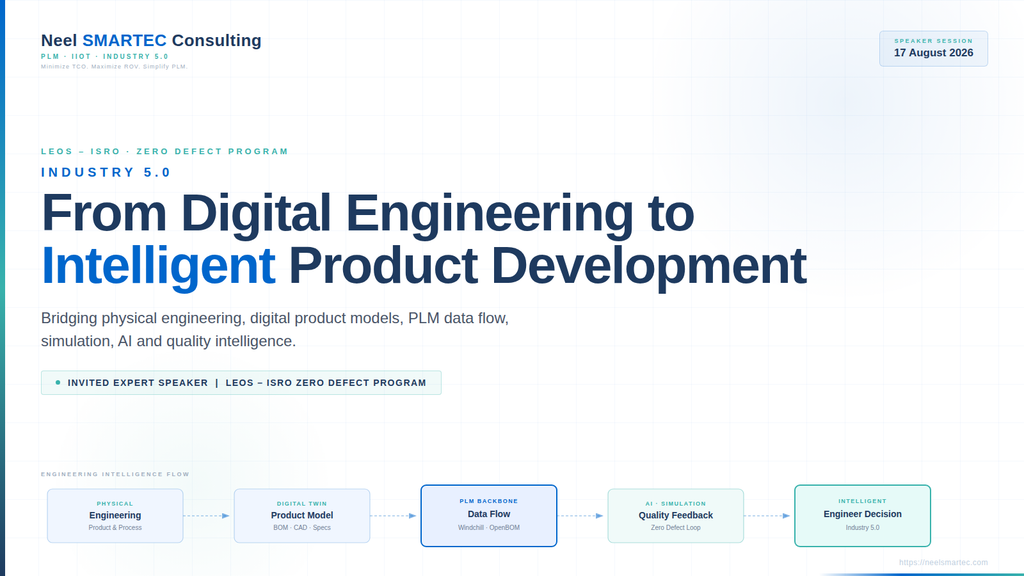
On 17 August 2026, I had the opportunity to join LEOS–ISRO as an invited expert speaker as part of the Zero Defect Program, sharing perspectives on Industry 5.0 and its implications for digital engineering and intelligent product development.
The session explored a simple but important question:
After more than 20 years of working with engineering and manufacturing organisations, I believe this is becoming one of the most important questions for product development.
What the audience took away
Feedback following the session highlighted the value of the discussion around Product Lifecycle Management (PLM) and Industrial Internet of Things (IIoT), particularly how their combination can create a continuous flow of information between engineering and manufacturing teams.
The discussion on predictive maintenance, asset monitoring, quality management, digital twins and data-driven decision-making was also noted as helping connect these concepts to real-world manufacturing applications.
The feedback also suggested that more case studies and implementation examples would help explore the challenges of integrating PLM and IIoT systems in greater depth.
I found that particularly valuable. Understanding what technology can do is one thing. Understanding how to implement it effectively is another.
The information exists. The continuity may not.
We have more engineering information today than ever before.
CAD models. BOMs. Specifications. Simulation results. Test results. Quality data. Manufacturing information. Service information.
Yet, in many engineering environments, the challenge is not simply finding information. It is understanding whether the information is the right version, why a decision was made, what changed, what may be affected and what was learned previously.
This is where PLM has an important role.
PLM should not be viewed simply as a place to store CAD files and documents. Its greater value is in maintaining relationships between product information, configurations, changes, decisions, processes and lifecycle feedback.
Having PLM is not necessarily the same as having digital continuity.
From digital engineering to engineering intelligence
Once information is connected, we can begin to do more than manage it.
- AI and analytics can help identify patterns and find relevant knowledge.
- Simulation can help us explore possibilities before physical realisation.
- Automation can reduce repetitive engineering activities.
- Digital twins can connect digital representations with information from the physical product, process or asset.
But technology alone does not make engineering intelligence.
Connected information gives us context. Technology helps us analyse, explore and execute. People bring judgement, experience and responsibility.
This distinction is important.
I have seen situations where a process was automated and became faster, but the underlying process or information was not sufficiently ready.
The result? The process became faster without necessarily becoming better.
Quality should become part of the learning loop
Inspection and testing are often viewed as activities that happen after manufacturing. But there is a bigger opportunity.
What if inspection results do more than tell us whether a product passed or failed?
What if they also help engineering understand the product, the process or even the original design decision?
Suppose a dimensional deviation occurs repeatedly. The immediate response may be to correct the manufacturing process. But engineering should also be able to ask:
- Has this happened before?
- Is there a manufacturing trend?
- Is the tolerance appropriate?
- Is the material behaviour understood?
- Should the design itself be reconsidered?
When inspection information is connected to the product and its engineering context, it becomes more than quality control. It becomes engineering intelligence.
Digital twins are valuable when they answer a real question
The same principle applies to digital twins.
A CAD model is not automatically a digital twin. A simulation model is not automatically a digital twin either.
The value comes from connecting the digital representation with relevant information from the physical product, process, asset or system.
The important question is therefore not: “Do we need a digital twin?” It is: “What engineering or operational problem will the digital twin help us understand or solve?”
If it helps us understand behaviour, monitor performance, predict an outcome, investigate a problem or improve a decision, it can create real value.
The sophistication of the solution should follow the engineering need — not the other way around.
Industry 5.0 is bigger than technology
This is where I see the real significance of Industry 5.0.
PLM, IIoT, AI, automation, simulation and digital twins are important enablers. But Industry 5.0 is ultimately about creating human-centric, sustainable and resilient industrial systems.
Sustainability needs to enter engineering decisions while choices are still open — through material selection, product architecture, manufacturing, energy use, repairability, reuse and lifecycle considerations.
Resilience is not only about resilient technology. It is also about people, processes and engineering knowledge.
An organisation may have the CAD model, drawing and specification, but still lose valuable knowledge when an experienced engineer moves on. The real question is not only: “What is the product?” It is also: “Why was it designed this way, what changed, and what did we learn?”
Digital continuity can help preserve that knowledge where it matters.
Start with the problem, not the technology
The constructive feedback about the need for more implementation examples reinforces an important principle from my consulting experience.
The conversation should not begin with: “Which technology should we implement?” It should begin with: “What engineering problem are we trying to solve?”
Before introducing a new technology, ask:
- What problem are we solving?
- Where does it occur in the product lifecycle?
- What information is required?
- Who needs to act on that information?
- How will we know that the situation has improved?
This helps separate technology capability from engineering capability.
The real Industry 5.0 transition
Industry 5.0 does not mean replacing Industry 4.0. It does not mean replacing engineers. And it does not mean simply adding another technology layer.
It means building on the digital foundation we already have and using it with greater purpose:
- To augment human capability.
- To make better engineering decisions.
- To design more sustainably.
- And to build more resilient products and organisations.
The future of engineering is not humans versus technology. It is about how effectively humans and technology can work together.
And perhaps that is the most meaningful way to look at Industry 5.0: Not less technology. Not more technology for its own sake. But technology used with greater purpose.
Explore Further
Discover how structured advisory models can guide your digital transformation journey.
Explore Neel SMARTEC ServicesPlanning a PLM or Digital Transformation Initiative?
Discuss your roadmap priorities, engineering data challenges, or PLM readiness gaps with Neel SMARTEC.
Schedule a Strategy Discussion