
Industry Insights | Uthayan Elangovan | July 2025
An industry perspective following an invited guest session with the Vestas PLM Operations team, Chennai.
Over the past 22+ years in Product Lifecycle Management, I have seen PLM evolve from engineering data management and document control to enterprise-wide product lifecycle platforms connected to manufacturing, supply chain, and service operations. The technology has changed considerably. The expectations from PLM have changed too. Yet, one observation remains consistent across organizations: implementing a PLM system does not automatically make product development and lifecycle operations simpler. Teams still spend time correcting material information, checking BOMs, resolving engineering changes, managing product configurations, and reconciling information between PLM and ERP.
Now, Artificial Intelligence is entering this landscape.
There is considerable discussion about AI-powered PLM, intelligent automation, predictive analytics and digital threads. These developments bring interesting possibilities. But having worked with PLM across different industries, I believe we need to look at a more fundamental question.
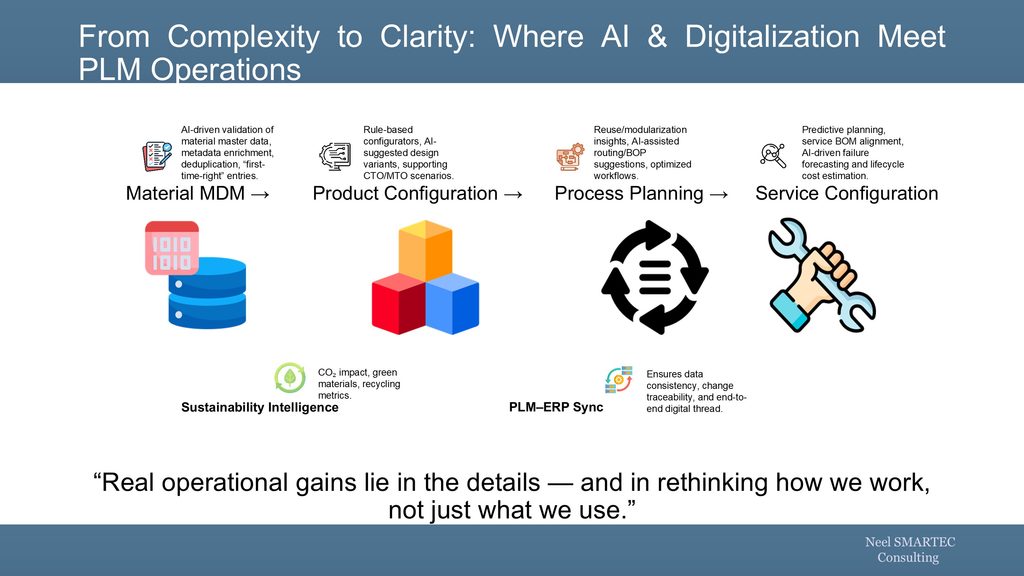
“Where does intelligence actually help the people who manage product information and lifecycle processes every day?” This was the focus of my invited guest session with the Vestas PLM Operations team in Chennai in July 2025, where we explored the potential of AI and digitalization in PLM operations. Rather than looking at AI as another technology initiative, I approached the discussion from the perspective of everyday operational challenges.
The problem is not always the absence of technology
In my experience, organizations often have substantial investments in PLM, ERP and other enterprise systems. They have established workflows, defined processes and teams responsible for maintaining product information. But when you look closely at how work gets done, there are still many manual activities.
Consider material master data.
A new material or part is created, someone needs to check whether it already exists, whether the classification is correct and whether all the necessary attributes have been maintained. These checks may appear routine, but mistakes can travel through the product lifecycle, besides they affect BOMs, procurement, costing, manufacturing and sometimes service. The question I would ask is not whether we need another application to manage material data. It is whether we can make the existing process more intelligent.
AI-assisted validation could help identify similar material records, suggest classifications and highlight missing information while a user creates a record. But there is an important condition – the organization must first have clarity on its material standards, classification rules and data ownership. Without that foundation, AI may simply help create incorrect information faster. This is where I see the real opportunity: allowing experienced people to spend less time on repetitive checking and more time resolving exceptions and making decisions.
Sustainability needs to become part of engineering decisions
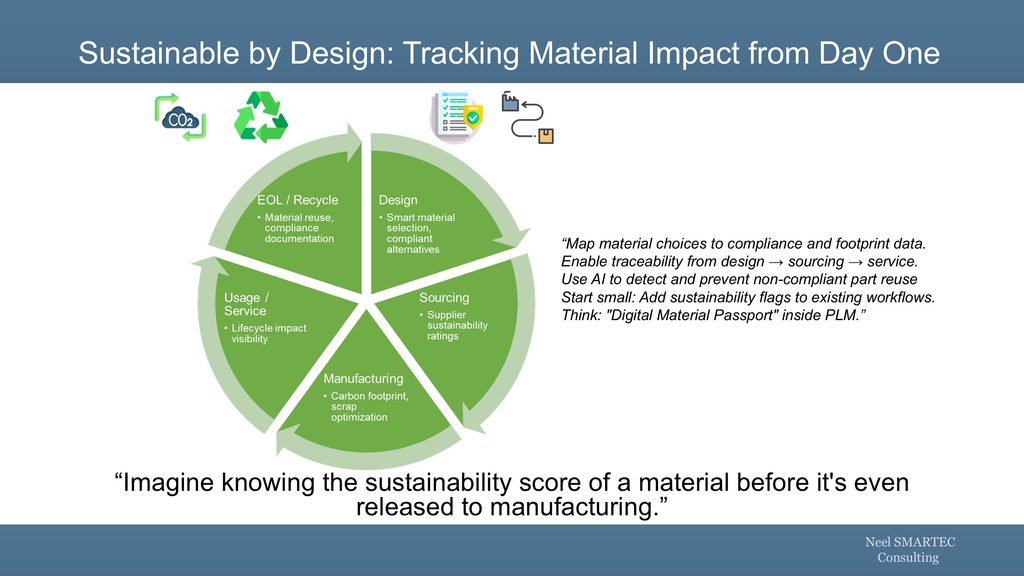
Another area I find particularly interesting is sustainability. For manufacturers in the renewable energy sector, sustainability has implications for material selection, product design, sourcing and the entire lifecycle. However, environmental information does not always reach the engineer at the point where a material or design decision is made. Imagine an engineer comparing two material alternatives. Technical performance, cost and availability are available, but environmental impact and recyclability information are maintained elsewhere. That creates an information gap. With better integration and intelligent data analysis, PLM could provide relevant sustainability information as part of the material selection process. The engineer would have a better understanding of the implications of the decision before the design moves forward. I believe this is an important shift. Sustainability information should influence those decisions from the beginning. Of course, this requires reliable supplier information, agreed sustainability criteria and integration with the relevant data sources. AI alone cannot provide that foundation.
Product configuration: Complexity grows with every variant
Anyone working with complex engineered products understands how quickly product configuration can become difficult to manage. Wind turbines are a good example. Different wind conditions, tower heights, grid requirements and country-specific regulations influence the final product configuration: Configure-to-Order and Make-to-Order approaches help manufacturers manage this variation. As product options increase, engineering teams must ensure that selected components are compatible, configurations are valid, BOMs are accurate and the resulting product can actually be manufactured and serviced. In many organizations, some of these checks happen through a combination of system rules, spreadsheets and manual reviews. This is an area where I see AI complementing established PLM configuration capabilities. For example, AI could help identify unusual combinations, suggest suitable alternatives based on historical configurations and highlight potential inconsistencies. However, I would not replace engineering configuration rules with AI-generated decisions. Product constraints, engineering standards and approved configuration logic must remain authoritative. The value comes from combining structured product knowledge with intelligent assistance.
The digital thread should not stop at engineering
One of the biggest opportunities in PLM is connecting engineering information with what happens after a product reaches the customer. Over the years, I have seen considerable attention given to engineering BOMs, manufacturing BOMs and engineering change management, whereas the connection with service and field operations deserves equal attention. Consider a manufacturer managing equipment installed across different geographical locations. Each asset operates under different conditions. Usage patterns, environmental factors and maintenance histories influence component performance. IIoT and SCADA systems can provide operational information from the field. AI can help identify patterns that may indicate component degradation or potential failure. But identifying a potential problem is only part of the requirement. The information must eventually support an operational decision.
Which product configuration is affected? Which component revision is installed? Is there an approved replacement? What does the service BOM contain? Are the required parts available? This is where PLM becomes important. Connecting operational information with product structures, revisions and service configurations creates an opportunity to improve maintenance and service planning. The benefit is not simply predicting failures. It is helping service teams understand what action needs to be taken. For manufacturers with large installed equipment populations, this connection between product engineering and field operations deserves serious consideration.
PLM and ERP: Integration is not just about transferring BOMs
Another discussion that frequently comes up in PLM programmes is the relationship between PLM and ERP. Where should product information reside? Which system owns the BOM? How should engineering changes reach procurement and manufacturing? Having worked across PLM implementations and integrations, I find that these questions need to be addressed from an information ownership perspective rather than simply from a system perspective.
PLM maintains the engineering definition of the product, including product structures, revisions and engineering changes. ERP manages business transactions such as procurement, inventory, costing and production planning.
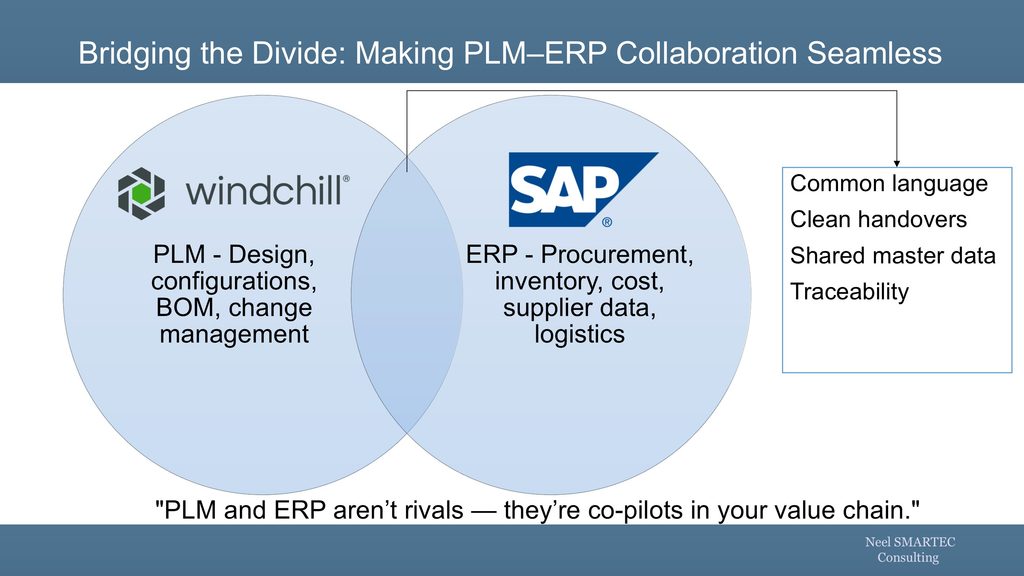
The two systems have different responsibilities, but they must work with consistent information. When this relationship is not properly defined, teams end up reconciling material records, checking BOM differences and manually following up on engineering changes. AI could help identify inconsistencies between systems and flag missing or incomplete information. But before introducing such capabilities, organizations need to establish which system owns which information, when it should be exchanged and how changes are controlled. In my view, a well-designed PLM–ERP integration is one of the most important foundations for digital manufacturing. AI can improve the intelligence around that integration, but it cannot replace the need for a sound integration strategy.
Modularization: An opportunity that deserves more attention
There is another subject that I believe has a direct impact on PLM effectiveness: modularization. Manufacturers often develop multiple product variants, but not every component or assembly is unique. There may be opportunities to reuse standard modules, assemblies and approved configurations across products, but the challenge is that reuse does not happen simply because a PLM system has a reuse function. It requires a deliberate product architecture, engineering standards and an understanding of where standardization makes business sense. Without these, organizations can accumulate similar parts and assemblies over time, making product structures increasingly difficult to manage.
AI could assist in identifying similar components, suggesting existing modules and helping engineers find reusable product information. But the real work is establishing a modularization strategy and ensuring that engineering teams follow it. When done properly, modularization can reduce repetitive engineering effort, simplify configuration management and improve consistency across manufacturing and service. It is also one of the areas where improvements in engineering practices can create benefits well beyond the engineering department.
So, where should manufacturers start with AI in PLM?
After exploring these opportunities, I would bring the discussion back to a question that I often ask when looking at PLM improvement initiatives: What is making the current process difficult, and where are people spending time that could be better used elsewhere? For one organization, the immediate issue may be duplicate material records. For another, it may be engineering change delays or configuration complexity. Another may be struggling to connect engineering information with manufacturing and service operations. These are different problems. They should not all lead to the same AI solution. I would first understand how the process works today, where information gets disconnected, what decisions require manual intervention and why existing systems are not delivering the expected value. Only then does it become meaningful to evaluate whether AI, automation, better integration or process improvements are appropriate. There is no reason to introduce AI where a straightforward process correction would solve the problem. Equally, there is no reason to ignore AI where it can genuinely reduce repetitive work, improve information quality or help people make better-informed decisions.
My perspective after 22+ years in PLM
Having worked with different PLM platforms, engineering teams and manufacturing environments, I have come to believe that the success of PLM is measured by how effectively people use those capabilities to manage products, make decisions and support business operations. AI brings another opportunity to improve that effectiveness. But the foundations remain the same: people who understand the processes, reliable product information, clearly defined responsibilities and systems that work together. The next stage of PLM will be about applying it where it makes a meaningful difference. The objective should be simple: less time managing information, less effort resolving avoidable issues and more time making informed product and business decisions. That is where I see the real potential of AI and digitalization in PLM operations.
Continuing the Conversation
The questions around AI, PLM and digitalization are not limited to technology. They are closely connected to how organisations manage product information, engineering processes and decisions across the lifecycle. These are areas I continue to explore through industry engagements, PLM advisory work and professional publications. If your organization is looking at improving PLM utilization, addressing engineering process challenges or identifying where AI and digitalization can make a practical difference, these discussions are worth having before deciding on the next technology investment.
Speaking & Industry Engagements:
Industry Perspectives on PLM, Digital Transformation & Industry 5.0
- Industry Perspectives on PLM, Digital Transformation & Industry 5.0
- Handbook of Product Lifecycle Management
For industry speaking engagements, leadership discussions or practical PLM improvement initiatives, connect with Neel SMARTEC Consulting.