
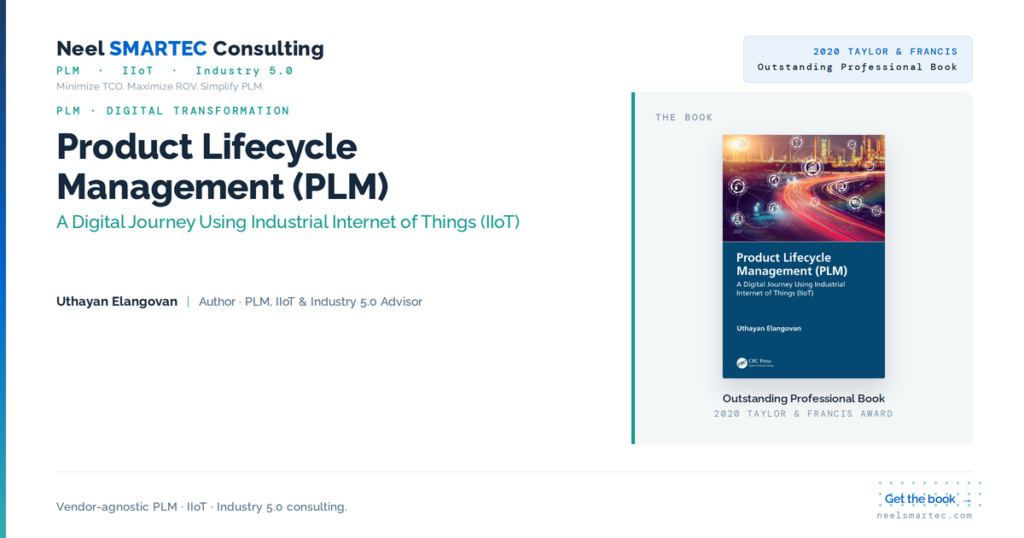
Product Lifecycle Management (PLM)
A Digital Journey Using Industrial Internet of Things (IIoT)
As manufacturing becomes increasingly connected, PLM must evolve beyond managing engineering data to enabling collaboration across the entire product lifecycle. This award-winning practitioner guide explores how IIoT extends PLM by integrating product, manufacturing, and operational data into a connected digital ecosystem.
Drawing on practical industry experience, the book explains how organizations can improve product development, manufacturing, quality, service, and lifecycle decision-making through integrated PLM and IIoT strategies.
The book, in five facts
Modern products keep generating data long after they leave the factory
Yet in many organizations, engineering, manufacturing, quality, and service continue to operate in disconnected systems, making it difficult to use that information to improve future products.
This book presents a practical perspective on connecting Product Lifecycle Management with Industrial Internet of Things technologies to create a continuous flow of information across the product lifecycle — bringing engineering knowledge and operational insight together to support data-driven product development, connected manufacturing, and continuous improvement.
Whether you’re beginning your PLM journey, modernizing an existing environment, or exploring Industry 4.0 initiatives, this book provides the concepts, frameworks, and practical examples needed to understand how connected lifecycle management supports long-term business value.
Connecting PLM and IIoT across the product lifecycle
Digital transformation in manufacturing is no longer limited to automating individual processes or deploying isolated software. Organizations are increasingly seeking ways to connect engineering, manufacturing, quality, supply chain, and service into a continuous flow of information that supports better decisions throughout the product lifecycle.
PLM provides the foundation for managing product information from concept through design, manufacturing, service, and retirement. IIoT enables manufacturers to collect operational data from machines, production systems, and connected products operating in the real world. When these two disciplines work together, manufacturers gain more than visibility into engineering data — they create a closed-loop lifecycle where operational insights continuously inform product development, manufacturing improvements, quality initiatives, and service strategies.
Key themes explored throughout the book
PLM Foundations
The processes, components, and business value of Product Lifecycle Management.
Connected Digital Ecosystems
Integrating PLM with enterprise systems such as ERP, MES, ALM, SCM, and Service Lifecycle Management.
Industrial Internet of Things
Leveraging operational data to enhance engineering and manufacturing decisions.
Smart Product Development
Managing the lifecycle of connected products from concept to service.
Digital Collaboration
Enabling cross-functional teams to work from a shared, trusted source of product information.
Industry 4.0 Technologies
How cloud computing, additive manufacturing, simulation, analytics, and automation complement PLM.
Practical Industrial Use Cases
How integrated PLM and IIoT strategies create measurable business value through real-world scenarios.
PLM manages the digital definition of a product, while IIoT enriches that definition with real-world operational intelligence — creating a continuous digital thread across the product lifecycle.
Why this book was written
The convergence of Product Lifecycle Management and the Industrial Internet of Things has transformed the way manufacturers create, build, and support products. While PLM manages the digital definition of a product and IIoT generates operational intelligence from manufacturing and connected products, there has often been limited practical guidance on how these domains work together across the enterprise.
Drawing on hands-on experience with PLM implementations and digital manufacturing initiatives, this book explores that connection — explaining how engineering information, manufacturing operations, quality processes, and product performance data can be integrated to create a continuous digital thread that supports better collaboration, faster decision-making, and continuous product improvement.
This book was inspired by a simple question encountered during real-world PLM and IIoT engagements: How can engineering information and operational data be connected across the manufacturing enterprise to create greater business value? The chapters that follow explore that question through practical concepts, integration approaches, and industrial use cases.
Turning disconnected product data into business value
Many manufacturers have invested in engineering and enterprise systems such as CAD, PLM, ERP, MES, and quality management — yet product information often remains fragmented across departments, making it difficult to maintain a consistent view of the product throughout its lifecycle. Manufacturers exploring PLM, IIoT, or broader digital transformation often encounter:
- ✓Product information distributed across disconnected systems and teams
- ✓Limited visibility into product data beyond the engineering phase
- ✓Engineering, manufacturing, quality, and service working from different versions of product information
- ✓Difficulty integrating operational insights into future product development
- ✓Increasing product complexity and more demanding customer expectations
- ✓Challenges in measuring the business value of digital transformation initiatives
A structured introduction to connected lifecycle management
Readers will learn how to:
- ✓Understand the role of PLM as the foundation for product information management
- ✓Explore how IIoT extends PLM by incorporating real-world operational data
- ✓Connect engineering, manufacturing, quality, and service through an integrated digital ecosystem
- ✓Understand the relationships between PLM, ERP, MES, ALM, SCM, and Service Lifecycle Management
- ✓Apply Industry 4.0 technologies to strengthen product lifecycle processes
- ✓Evaluate practical implementation approaches through business-oriented use cases
- ✓Recognize how connected lifecycle management contributes to innovation, efficiency, and informed decision-making
A continuous feedback loop across the lifecycle
The value of PLM is no longer limited to managing engineering data. Combined with IIoT, it becomes part of a continuous feedback loop where information flows across the entire product lifecycle.
By connecting product information with operational intelligence, organizations create a digital thread that supports collaboration, accelerates innovation, and enables continuous improvement throughout the lifecycle.
Build a strong foundation for connected PLM
This book takes you through the principles, technologies, and practical approaches that enable PLM to support modern digital manufacturing. By the end, you’ll be able to:
Understand PLM Fundamentals
Core components including product data management, change management, quality management, supplier collaboration, manufacturing process management, and project management.
Build an Integrated PLM Ecosystem
How PLM connects with ERP, MES, SCM, ALM, and Service Lifecycle Management for a seamless flow of product information.
Explore the Role of IIoT
How operational data from machines, production systems, and connected products enhances development and decision-making.
Develop Smart Connected Products
Designing, developing, validating, launching, and supporting smart connected products across their lifecycle.
Connect Engineering with Manufacturing
How digital collaboration lets teams work from trusted product information, improving consistency and speed.
Apply Industry 4.0 Technologies
How additive manufacturing, cloud computing, simulation, robotics, analytics, and AR complement PLM initiatives.
Learn Through Practical Use Cases
How integrated PLM, ERP, MES, and IIoT environments address common manufacturing challenges.
Measure Business Value
How connected lifecycle management improves quality, efficiency, innovation speed, and ROI.
A complete map of connected lifecycle management
- ✓Product Lifecycle Management fundamentals
- ✓Product Data Management (PDM)
- ✓Manufacturing Process Management (MPM)
- ✓Engineering Change Management
- ✓Quality and Supplier Management
- ✓PLM ecosystem integration
- ✓ERP, MES, ALM, SCM, and SLM connectivity
- ✓Industrial Internet of Things
- ✓Smart Product Development
- ✓Digital Collaboration
- ✓Industry 4.0 technologies
- ✓Connected manufacturing
- ✓Digital Thread concepts
- ✓Industrial implementation use cases
- ✓Business value and ROI
A chapter-by-chapter journey through connected PLM
Seven chapters progressively build an understanding of PLM, IIoT, and their role in enabling connected manufacturing — each introducing key concepts before expanding into integration strategies, enabling technologies, and practical industrial applications.
The foundations of PLM — Product Data Management, Manufacturing Process Management, Change Management, Quality Management, Supplier Management, and Project Management — and how they work together.
How PLM integrates with ERP, MES, ALM, SCM, and Service Lifecycle Management to create a collaborative digital enterprise prepared for Industry 4.0.
From operational technology and process control systems to connected devices and predictive analytics — how operational data creates new opportunities.
How connected products are designed, developed, validated, launched, and supported — product architecture, protocols, prototyping, QA, certification, and post-launch improvement.
How PLM and IIoT complement each other to create digital collaboration across engineering, manufacturing, and service.
Additive manufacturing, cloud computing, robotics, simulation, augmented reality, analytics, and automation — and how they strengthen PLM.
Practical scenarios showing how PLM, ERP, MES, and IIoT work together — plus methods for evaluating ROI and measuring business value.
Practical insight for anyone connecting engineering and operations
Whether you’re leading digital transformation, managing engineering data, developing products, or exploring PLM for the first time, this book offers practical insight into connecting engineering, manufacturing, and operational intelligence across the product lifecycle. Rather than focusing on one software platform or industry, it presents principles that apply across discrete manufacturing sectors.
Engineering & Product Development
Understand how PLM supports structured product development, engineering collaboration, and lifecycle governance.
Manufacturing & Operations Leaders
Learn how operational data and IIoT improve manufacturing performance and feed back into product development.
PLM & Digital Transformation Professionals
Gain a practical understanding of integrating PLM with enterprise systems and Industry 4.0 technologies.
Business & Technology Leaders
Explore how connected lifecycle management supports strategic decision-making, innovation, and operational excellence.
IT & Solution Architects
Understand PLM’s role within the broader enterprise ecosystem, including ERP, MES, ALM, SCM, and IIoT platforms.
Consultants & System Integrators
Build a broader perspective on implementing connected product lifecycle strategies across manufacturing organizations.
Students & Academics
Develop a foundational understanding of PLM, IIoT, and digital manufacturing through practical, industrial examples.
Bridging engineering, manufacturing, and digital transformation
Digital transformation in manufacturing requires more than adopting new technologies — it requires connecting people, processes, and product information across the enterprise. Rather than focusing on a specific software platform or methodology, this book presents vendor-neutral concepts applicable across a wide range of manufacturing environments.
A Practitioner’s Perspective
Written from hands-on industry experience, combining engineering, manufacturing, and digital transformation thinking focused on real business challenges.
Connecting PLM and IIoT
Explains how engineering information and operational intelligence complement one another to support informed decision-making.
Technology-Neutral Concepts
Applicable regardless of the PLM, ERP, MES, or IIoT platforms an organization chooses.
A Structured Learning Journey
Progresses from PLM fundamentals through enterprise integration, smart products, Industry 4.0, and practical use cases.
Practical Manufacturing Focus
Concepts presented in the context of real manufacturing environments — engineering, manufacturing, quality, supply chain, and service.
Recognized Professional Contribution
Received the 2020 Taylor & Francis Outstanding Professional Book Award for advancing PLM and IIoT knowledge.
The need for connected product information remains fundamental
Although digital technologies continue to evolve, organizations keep investing in PLM, enterprise integration, and digital manufacturing initiatives to improve collaboration, product quality, operational efficiency, and lifecycle decision-making.
The concepts presented in this book provide a foundation for understanding how engineering and operational data work together to support continuous improvement and long-term digital transformation.
Explore more publications on digital manufacturing
PLM is one part of the broader digital transformation journey. Together, these publications provide a progressive learning path — from IIoT foundations, through connected PLM, to Industry 5.0 and an in-depth PLM reference.
Smart Automation to Smart Manufacturing
Introduces the foundations of connected manufacturing and Industrial Internet of Things.
Explore the Book →PLM: A Digital Journey Using IIoT
Demonstrates how engineering and operational intelligence work together across the product lifecycle.
Industry 5.0: The Future of the Industrial Economy
Explores the future of manufacturing — human expertise, intelligent automation, sustainability, and resilient operations.
Explore the Book →Handbook of Product Lifecycle Management
An in-depth reference for advancing PLM strategy, implementation, and digital transformation.
Put connected lifecycle thinking into practice
Understanding the principles of PLM and IIoT is the first step. Successfully applying them requires aligning business processes, engineering data, enterprise systems, and digital transformation objectives. Neel SMARTEC Consulting helps manufacturers translate these concepts into practical strategies and implementation roadmaps, with a vendor-independent approach focused on business outcomes.
PLM Strategy & Roadmap
A clear roadmap for adopting or modernizing PLM, aligned with your business goals, product complexity, and transformation priorities.
PLM Capability & Maturity Assessment
Evaluate current PLM capabilities, identify process and technology gaps, and establish a phased improvement plan.
PLM Vendor Selection
Select the right PLM solution through objective evaluation of requirements, processes, scalability, integration, and TCO.
Engineering Data & Digital Thread Assessment
Improve engineering data quality and product information flow to establish a connected digital thread.
PLM Implementation Advisory
Independent guidance on governance, best practices, change management, integration strategy, and business adoption.
Common questions about the book
Yes. It introduces the core principles of PLM before exploring more advanced topics such as enterprise integration, IIoT, smart product development, and Industry 4.0 technologies — suitable for both newcomers and experienced professionals.
No. The book is vendor-neutral. It explains the business processes, lifecycle concepts, integration approaches, and digital transformation principles applicable across different PLM platforms and manufacturing environments.
It explains how operational data generated by manufacturing systems and connected products complements PLM by creating a continuous flow of information across engineering, manufacturing, quality, and service.
Engineering professionals, product development teams, manufacturing leaders, PLM practitioners, digital transformation professionals, IT architects, consultants, researchers, and students.
Yes. It combines foundational concepts with practical implementation approaches and industrial use cases showing how PLM, ERP, MES, and IIoT work together to deliver measurable business value.
Yes. While digital technologies continue to advance, the need to connect engineering information with operational intelligence remains fundamental to modern manufacturing and digital transformation initiatives.
Absolutely. It serves as an introductory reference for higher education and professional learning, while also offering practical perspectives for engineering teams and organizations.
The book provides the foundational knowledge needed to understand connected PLM. If you’re planning an implementation, evaluating your capabilities, or building a digital transformation roadmap, Neel SMARTEC Consulting offers independent, tailored advisory services.
Start Your Connected PLM Journey
Digital transformation begins with connecting product information, engineering knowledge, and operational intelligence across the manufacturing enterprise. This book provides a practical foundation for understanding how PLM and IIoT work together to create a connected product lifecycle.
Access the official edition from CRC Press / Routledge, or discover vendor-independent advisory services for PLM strategy, digital transformation, and engineering excellence.