
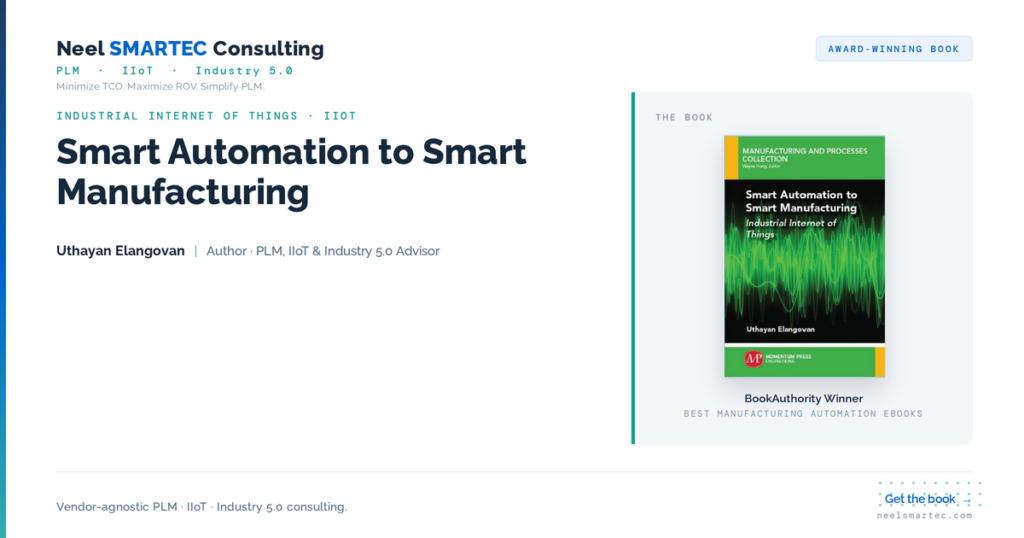
Smart Automation to Smart Manufacturing
Understanding Industrial Internet of Things (IIoT) and Connected Manufacturing
Manufacturing is changing. Machines, products, software, and people are becoming more connected than ever before. This book explains IIoT in plain language and shows how connected technologies improve the way products are designed, manufactured, and maintained.
Whether you’re an engineer, manufacturing professional, student, or business leader, this is a practical foundation for understanding smart manufacturing.
Technology is changing manufacturing. Understanding it shouldn’t be difficult.
A few years ago, manufacturing was mainly about machines, automation, and production efficiency. Today, manufacturers are expected to connect machines, collect data, monitor performance in real time, and make faster decisions.
Along the way, new terms such as Industry 4.0, IoT, Digital Factory, and Smart Manufacturing became part of everyday conversation. For many professionals, the biggest challenge wasn’t learning another new technology — it was understanding how all these ideas fit together and what they meant for manufacturing.
This book was written to answer those questions in a practical way. Instead of focusing only on technology, it explains how connected systems support better engineering, production, maintenance, quality, and business decisions.
My journey into Industrial Internet of Things
When I first came across the term Internet of Things, it immediately caught my attention. Coming from a Product Lifecycle Management (PLM) background, I was curious what this new technology meant for manufacturing.
That curiosity led me to spend countless hours reading technical blogs, following industry experts, watching conference presentations, and studying real-world examples. I wasn’t looking for another technology to learn — I wanted to understand how connected devices could solve practical manufacturing problems.
As I became involved in IIoT projects on the ThingWorx platform, the concepts started coming together. I saw that IIoT was about far more than connecting machines — it was about connecting engineering, production, maintenance, operations, and business information to improve the entire manufacturing process. The experience pushed me to look beyond my own expertise and understand manufacturing end to end, from product design through production, quality, maintenance, and after-sales support.
Along the way, I realised many engineers and manufacturing professionals were asking the same questions I had: What is IIoT? How is it different from IoT? Where does Industry 4.0 fit in? How can manufacturers actually use these technologies?
This book is my attempt to answer those questions clearly and practically — combining what I learned through research with what I experienced on real manufacturing projects. My goal was simple: to write the book I wish I’d had when I first started exploring IIoT.
Written for people who want to understand modern manufacturing
Whether you’re beginning your digital transformation journey or strengthening your understanding of connected manufacturing, this book provides a practical starting point. It’s especially useful for:
Manufacturing Leaders
Gain a clear understanding of how connected technologies improve productivity, visibility, and decision-making across operations.
Plant & Operations Managers
Understand how machines, production systems, and operational data work together to improve day-to-day performance.
Engineers
Whether in design, manufacturing, automation, quality, or maintenance — see how IIoT connects different engineering functions.
Digital Transformation Teams
Build a strong foundation before planning or implementing Industry 4.0 and IIoT initiatives.
Students & Researchers
Learn the fundamentals of Industry 4.0, IoT, and IIoT through practical manufacturing examples rather than theory alone.
A practical understanding of Industrial Internet of Things
This book takes you step by step through the ideas behind Industry 4.0 and IIoT — what these technologies are, and how they’re applied in manufacturing. By the end, you’ll understand:
- ✓How manufacturing has evolved through the Industrial Revolutions
- ✓What Industry 4.0 means and why it matters
- ✓The difference between IoT and Industrial IoT
- ✓How machines communicate using Machine-to-Machine (M2M) technologies
- ✓The role of sensors, devices, software, and communication in IIoT
- ✓How to plan an IIoT implementation
- ✓How IIoT supports process automation and Lean Manufacturing
- ✓Practical business applications of IIoT
- ✓Career opportunities in Industrial Internet of Things
A structured learning journey
Ten chapters, organised in four parts, that gradually build your understanding — from the evolution of manufacturing to practical IIoT implementation and business applications.
How manufacturing has evolved over time, and why each industrial revolution changed the way products are designed and produced.
The key principles behind Industry 4.0 and how digital technologies are reshaping manufacturing.
How machines communicate and exchange information without manual intervention.
The relationship between IoT and IIoT, and how industrial environments differ from consumer applications.
The devices, sensors, and assets that generate valuable manufacturing data.
The hardware, software, and communication technologies that make IIoT possible.
The practical steps involved in planning and implementing an IIoT initiative.
How IIoT supports process improvement, reduces waste, and enhances operational efficiency.
Practical examples of how IIoT is applied across different manufacturing environments.
The skills, roles, and opportunities available in one of the fastest-growing areas of manufacturing.
Built on practical learning and real manufacturing experience
There are many books and online resources that explain Industry 4.0 and IIoT. Most focus on the technology itself. This one takes a different approach — connecting the technology with engineering, production, quality, maintenance, and business operations.
The ideas here are shaped by hands-on IIoT initiatives, extensive research, and continuous learning from industry experts and practitioners. The goal isn’t to overwhelm you with technical detail, but to help you see how the concepts work together in real manufacturing environments.
What you’ll find in this book
- ✓Simple explanations without unnecessary technical jargon
- ✓Practical examples based on manufacturing environments
- ✓A step-by-step learning approach
- ✓A balance between technology and business value
- ✓Concepts that apply across different manufacturing industries
The fundamentals remain relevant
This book was first published in 2019, when Industry 4.0 and IIoT were becoming key topics across manufacturing. Since then, we’ve added Artificial Intelligence, Digital Twins, Edge Computing, and Industry 5.0 to the conversation — but the fundamentals haven’t changed.
Understanding how machines communicate, how data is collected, how connected systems work, and how manufacturing processes are integrated remains the foundation of every successful digital transformation initiative. Every new technology builds on strong fundamentals — this book focuses on those fundamentals.
Based on practical learning and real manufacturing experience
It combines extensive research with lessons learned working on Industrial IoT initiatives and helping manufacturers understand how connected technologies fit into their engineering and manufacturing processes. Rather than focusing only on technology, it explains how IIoT supports better decisions across engineering, production, quality, maintenance, and operations.
Working with manufacturing organisations
Based on real IIoT implementation and consulting
Engineering, production, quality, and operations focus
Internationally published by Momentum Press
Each book builds on the previous one
Smart manufacturing isn’t achieved through a single technology. It’s built by connecting products, processes, people, and information across the entire product lifecycle. This book introduces the fundamentals of IIoT and connected manufacturing — the books that follow extend those ideas into Product Lifecycle Management, and ultimately, Industry 5.0.
Whether you’re beginning with IIoT, strengthening your PLM knowledge, or preparing for Industry 5.0, each publication is designed to build on the previous one — a practical learning journey for engineers, manufacturing professionals, business leaders, and students navigating digital transformation.
Explore My Other PublicationsCommon questions about the book
Yes. It starts with the basics and gradually builds your understanding of Industry 4.0, IoT, and IIoT. No prior knowledge is required.
No. While engineers will find the technical concepts useful, it’s also written for manufacturing managers, plant leaders, digital transformation teams, students, and anyone interested in connected manufacturing.
Yes. The concepts are explained using practical manufacturing scenarios and implementation perspectives rather than academic theory alone.
Yes. Although first published in 2019, the fundamentals of connected manufacturing, machine communication, data collection, and IIoT remain essential for understanding today’s initiatives — including AI, Digital Twins, and Industry 5.0.
Industrial Revolution, Industry 4.0, Machine-to-Machine (M2M), IoT and IIoT, IIoT architecture, strategy and implementation, process automation, business use cases, and career opportunities.
Yes. It provides a structured introduction to IIoT and smart manufacturing, suitable for engineering students, postgraduate learners, researchers, and faculty.
The book is available in both print and digital formats through major online bookstores, including Amazon.
Start Your Journey Into Smart Manufacturing
Every digital transformation begins with understanding the fundamentals. If you want to learn how connected technologies are changing manufacturing — and how IIoT fits into that journey — this book is a practical place to start.
Reading is the first step. Applying the ideas within your organisation is where the real value is created.
If you’re exploring Product Lifecycle Management, Industrial Internet of Things, or digital transformation for your manufacturing business, I’d be happy to discuss your goals, challenges, and opportunities.
Schedule a Discussion