Engineering-to-Operations Intelligence: Why Information Flow Matters in Engineer-to-Order Manufacturing
Every Engineer-to-Order (ETO) manufacturer has a unique way of working. Each customer brings different requirements. Engineers modify existing designs or create new ones. Procurement sources materials, manufacturing builds the equipment, quality verifies it, and service teams support the customer after delivery. While every department performs its role well, one challenge is surprisingly common.
Information doesn’t always move as smoothly as the product does.
Recently, we worked with a food processing equipment manufacturer to understand how engineering information flowed from design through manufacturing and into operations. As with all our assessment engagements, the focus wasn’t on evaluating software. It was about understanding how people, processes, and information worked together. What we found is something many manufacturers may recognize.
Engineering Information Lives in Many Places
- During product development, information is created continuously.
- Design models are updated. Bills of Materials change. Supplier details are revised. Manufacturing requirements evolve. Customer requests introduce new changes.
- Each source contains valuable information, but no single place tells the complete story.
- As projects become more complex, teams spend increasing amounts of time confirming which information is current instead of moving the project forward.
The Challenge Isn’t the People
In most organizations, people are doing exactly what they have been asked to do.
- Engineering completes the design.
- Procurement purchases materials.
- Manufacturing builds the product.
- Quality performs inspections.
- Service supports the customer.
The challenge is that each function often works with its own view of the product. Small differences in information can lead to unnecessary questions, additional coordination, or avoidable rework.
Looking Beyond Individual Processes
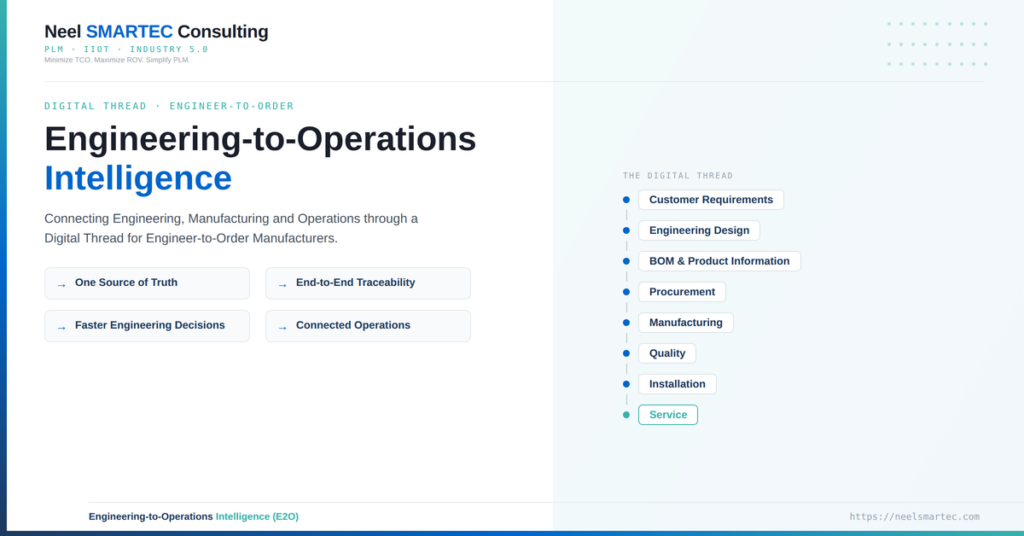
Rather than reviewing each department independently, we examined how information moved across the entire engineering-to-operations lifecycle.
We looked at questions such as:
- Where is product information created?
- Who owns each type of information?
- How are engineering changes communicated?
- How does the latest Bill of Materials reach manufacturing?
- Where are approvals recorded?
- Which activities rely on manual communication?
These conversations helped reveal where information flowed well and where it depended on individual effort rather than a defined process.
Small Gaps Often Have a Bigger Impact
Many of the observations were not major system issues.
Instead, they were everyday situations that gradually affect project execution.
Examples included:
- Engineering changes communicated through emails.
- Multiple versions of Bill of Materials being used.
- Manual transfer of information between departments.
- Difficulty tracing why a particular design decision was made.
- Different teams maintaining similar information in different places.
Individually, these may appear manageable. Together, they create delays, uncertainty, and additional work across the organization.
Building Engineering-to-Operations Intelligence
Our assessment focused on understanding how engineering information could move more consistently from design to manufacturing and beyond.
This included:
- Mapping information flow.
- Understanding ownership.
- Reviewing engineering change practices.
- Evaluating Bill of Materials management.
- Identifying opportunities to improve traceability.
- Defining practical improvement priorities.
The objective was not to recommend more technology. The objective was to create better visibility, clearer ownership, and smoother collaboration across functions.
Every Improvement Starts with Understanding
Many organizations begin their digital transformation journey by discussing software.
In our experience, it is often more valuable to first understand how information currently flows across the business. When organizations gain that understanding, they are better positioned to decide which improvements will deliver the greatest value, whether that involves process changes, governance improvements, or future technology investments.
Technology becomes more effective when it supports well-defined business processes.
Final Thoughts
Every Engineer-to-Order manufacturer is different. Yet many face similar challenges in connecting engineering with manufacturing and operations. Taking time to understand how information moves across the organization can uncover practical opportunities to reduce complexity, improve collaboration, and create a stronger foundation for future growth.
Sometimes, the most valuable step in digital transformation isn’t implementing something new. It’s gaining a clearer understanding of how your business already works.
Every improvement begins with understanding the current state. Within our Industrial Transformation Framework, the Engineering-to-Operations Intelligence Assessment provides manufacturers with a structured way to evaluate information flow, governance, and collaboration before planning their next stage of digital transformation.
Planning a PLM or Digital Transformation Initiative?
Discuss your roadmap priorities, engineering data challenges, or PLM readiness gaps with Neel SMARTEC.
Schedule a Strategy Discussion