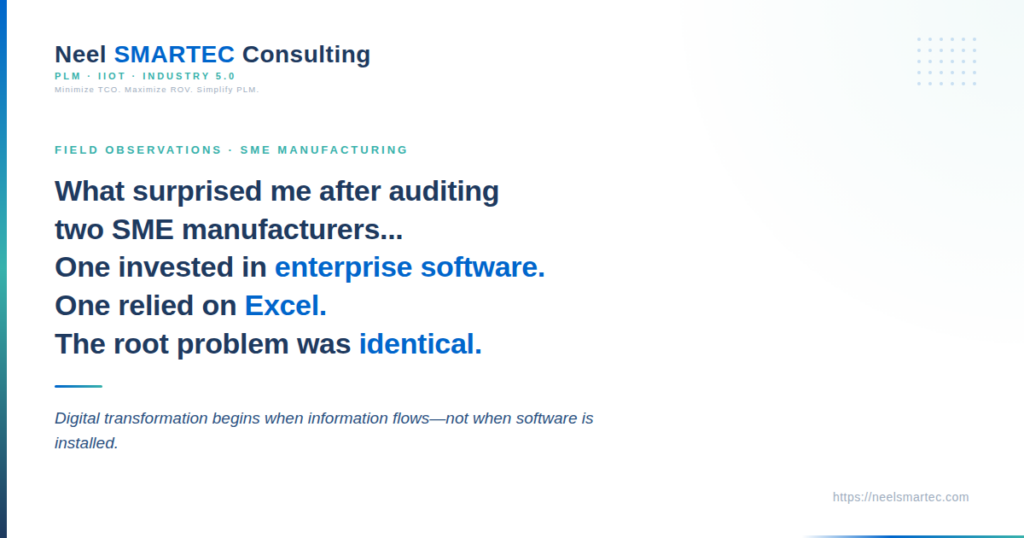
Over the past two weeks, I had the opportunity to audit two SME manufacturing companies.
On the surface, they couldn’t have been more different.
The first company had invested in modern technology. Dedicated engineering applications, manufacturing systems, structured business processes, and experienced teams were all in place. It appeared to be well along its digital transformation journey.
The second company relied almost entirely on Excel spreadsheets, emails, and manual coordination. There were no specialised engineering or manufacturing systems. Every department had developed its own way of managing information.
Naturally, one would expect the first organization to operate with far greater efficiency.
But what I found was surprising.
Both companies were fighting the same battle.
Different Tools. Identical Pain.
In the first organization, information existed—but it was scattered across multiple systems.
Engineering worked in one application. Manufacturing maintained another. Projects were tracked in Excel. Approvals travelled through emails and phone calls. Whenever a design changed, people became the integration layer. Teams spent valuable time finding information, validating versions, and coordinating across departments.
One of the biggest consequences of disconnected information is poor BOM traceability. Every engineering change, production delay, or procurement mistake has a root cause, and it is often hidden inside email chains and spreadsheet attachments. I explored this in Every Rework Has a Root Cause: The Hidden Cost of Email-Driven BOM Management.
The software existed. The connected workflow did not.
This is often how a PLM implementation loses its strategic purpose. Instead of becoming the backbone of product information, it ends up being used primarily as a document repository, a pattern I explored in “When PLM Becomes Just a Document Shelf.”
In the second organization, the situation was different—but the outcome was remarkably similar.
Excel had become the business system. Bills of Materials, revisions, production plans, procurement updates, and customer changes all depended on manually maintained spreadsheets. People knew where information was because they remembered it, not because the business had a reliable system. Everything worked… until it didn’t.
The Real Problem Isn’t Technology.
Many manufacturers immediately ask, “Which software should we buy?” But that is rarely the first question they should be asking. More often, the real challenge is identifying the business bottlenecks that deserve attention before selecting any technology.
At first glance, these organizations appeared to have opposite challenges. One seemed to need better integration. The other seemed to need digitalisation. But after looking deeper, both suffered from the same underlying issue.
Business information was disconnected.
When information is disconnected:
- Decisions become slower.
- Changes take longer to implement.
- Errors increase.
- Departments blame each other.
- Experienced employees become indispensable because they know where everything is.
- Firefighting becomes part of daily operations.
Whether the gap is between software applications or between Excel spreadsheets makes very little difference to the business outcome.
Technology Doesn’t Create Digital Transformation.
Many organizations believe digital transformation starts by purchasing new software. In reality, technology only amplifies the quality of existing business processes. If disconnected processes are digitised, organizations simply end up with digital silos instead of manual ones. True transformation begins when information flows seamlessly across the business, from engineering to manufacturing, procurement, quality, service, and management. The objective isn’t to have more software. The objective is to ensure everyone works from the same trusted source of product and business information.
Five Questions Every Manufacturing Leader Should Ask
If you’re leading a manufacturing business, ask yourself:
- How many times is the same information entered into different systems?
- How much time do teams spend searching for the latest version of a document or BOM?
- If a key employee is absent, can critical processes continue without disruption?
- How quickly can an engineering change reach manufacturing, procurement, and suppliers?
- Are your systems connected—or are your people acting as the connectors?
If these questions make you pause, your biggest opportunity may not be buying another software package. It may be redesigning how information flows across your business.
The Takeaway
Digital maturity is not measured by the number of applications you own. It is measured by how effortlessly your information moves, how confidently your people make decisions, and how consistently your processes perform.
One company had every tool. The other had only Excel.
Both were working harder than they needed to because information wasn’t working for them. That’s a reminder that every manufacturing leader should keep in mind before investing in the next technology platform.
Is Your Business Truly Connected?
If you’re wondering whether your organization is experiencing the same hidden inefficiencies, it may be time for an independent, business-focused assessment.
At Neel SMARTEC, we help manufacturers identify where disconnected information, fragmented processes, and manual workarounds are limiting business performance, before recommending any technology. The goal isn’t to sell software; it’s to build a practical digital roadmap that delivers measurable business value.
Sometimes, a few days of structured assessment can uncover improvement opportunities that save months of rework, delays, and firefighting.
If that sounds like a conversation worth having, I’d be happy to connect.
“I’ve discussed many of these principles in my books on PLM, IIoT and Industry 5.0.”
Planning a PLM or Digital Transformation Initiative?
Discuss your roadmap priorities, engineering data challenges, or PLM readiness gaps with Neel SMARTEC.
Schedule a Strategy Discussion