
PLM Readiness: Are You Truly Ready for a Successful PLM Implementation?
Most manufacturers don’t fail at PLM
because of technology.
They fail because they start before they are ready. If you are evaluating PLM — or struggling with an ongoing initiative — the real question is not which tool to choose. It is whether your organisation is prepared to make PLM work.
It is a transformation.
A PLM initiative touches how your organisation manages product data, controls engineering changes, connects cross-functional teams, and ensures traceability and compliance. That is not an IT project — it is a business transformation. And transformations require preparation.
PLM runs alongside Excel — not instead of it. Adoption stalls and old habits persist.
Duplicate, inconsistent data across systems. Nobody is sure which version is correct.
Poor user adoption. Teams route around the tool and revert to familiar workarounds.
Delayed ROI — or no ROI. Investment grows, confidence shrinks, leadership loses trust.
PLM adds complexity instead of removing it. A second system, not a better one.
Fixing problems mid-rollout costs far more than preventing them upfront.
actually lives
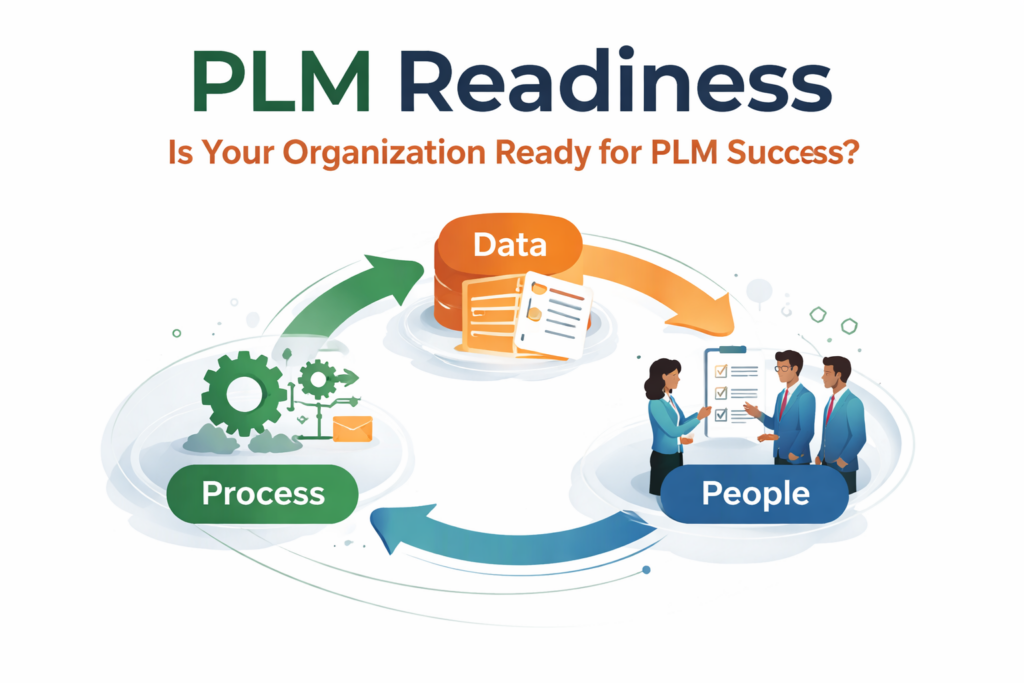
A successful PLM initiative depends on alignment across three dimensions. Most organisations have gaps in at least two — and most don’t know which two until they look deliberately.
Process Readiness
Are your engineering and change processes clearly defined — or dependent on individuals and workarounds? Can they be followed consistently across teams?
Common gap: Trying to fix broken processes using PLMData Readiness
Is your product data structured, consistent, and reliable — or spread across Excel files, emails, and disconnected systems with no single source of truth?
Common gap: PLM implemented on top of poor-quality dataPeople Readiness
Are teams aligned on why PLM is needed — with clear ownership, accountability, and active leadership sponsorship? Or is PLM seen as an IT project?
Common gap: PLM treated as IT, not business transformationThese three dimensions are not a standalone checklist. They form the core of Phase 1 (Empower) of the industrial transformation framework used across every PLM and IIoT engagement. Readiness is not a preliminary step. It is Phase 1.
to operational excellence
Three phases. One clear sequence. No phase can be skipped. Most organisations begin at Phase 2 — that is where PLM implementations quietly fail.
not ready — yet
These are not small issues. They are root causes of PLM failure. If you recognise more than two, pause before implementing.
where do you stand?
Rate your organisation honestly on each dimension — 1 (not in place) to 5 (consistently practiced). The descriptors below define what each end of the scale looks like in practice.
| Dimension | Score 1–2 looks like… | Score 4–5 looks like… | Your Score |
|---|---|---|---|
| Process Clarity | Engineering steps vary by person; workarounds are the norm | Processes are documented, followed, and regularly reviewed | __ / 5 |
| Data Consistency | Multiple BOM versions exist; nobody knows which is current | Single source of truth; product data is structured and governed | __ / 5 |
| Change Management | ECRs and ECOs happen informally or not at all | Change process is defined, tracked, and cross-functionally visible | __ / 5 |
| Cross-Team Alignment | Engineering, manufacturing, procurement use different data | Teams share a common product view with clear handoffs | __ / 5 |
| Leadership Alignment | PLM is seen as an IT or engineering problem | Leadership actively sponsors and owns the PLM initiative | __ / 5 |
It is a reason to prepare deliberately.
This self-check gives you a directional signal across five dimensions. For a precise, scored diagnostic across ten critical readiness factors — with a personalised roadmap reviewed by Uthayan — take the full 2-minute assessment.
is where every engagement begins
At Neel SMARTEC, PLM Readiness Assessment is not a discovery call or a preliminary form. It is a structured delivery within Phase 1 (Empower) of the E3 Framework — the foundation every engagement is built on. No blueprint is drawn until this phase is complete. No tool is selected. No implementation starts.
Understanding what the business actually needs PLM to achieve — not what a vendor has proposed. ROV and ROI baselines are defined at this stage, so success is measurable from day one, not declared retrospectively.
Evaluating process maturity, data governance, and organisational readiness across all three core dimensions. This is where gaps are identified — not discovered mid-implementation at significantly higher cost.
Identifying what will create friction during implementation before it does. Governance structures are defined. Ownership is clarified. Accountability is assigned — not assumed.
A practical, specific output — not a generic template. Built around your industry, your team, and your actual current state. This becomes the foundation for Phase 2 (Enhance): process blueprinting, proof of concept, and change management — where execution begins .
Drawn from 20+ years of PLM implementation experience across Windchill, ThingWorx, OpenBOM and IIoT platforms — automotive, medical, electronics, and industrial manufacturing.
“PLM success is not decided during implementation.— Uthayan Elangovan · Founder, Neel SMARTEC
It is decided before it begins.”
before you move forward
A focused, structured assessment to identify your critical gaps, prioritise actions, and define a realistic implementation path.